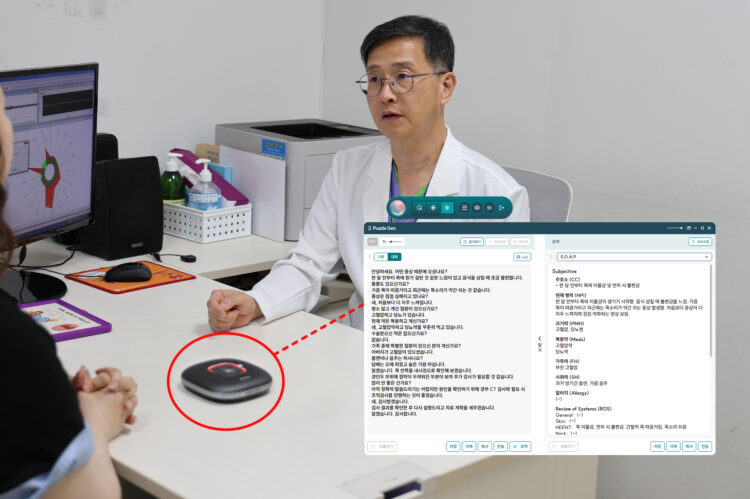
Clinicians at Keimyung University Dongsan Medical Center will soon be able to manage their entire medical-record workflow using only their voice, completely eliminating the need for a keyboard or mouse. The institution expects this technological shift to dramatically reduce administrative burdens, allowing healthcare providers to dedicate more time to direct patient care.
On June 8, Keimyung University Dongsan Medical Center announced that it had been selected as a final recipient of the 2026 AI Voucher Support Program, an initiative spearheaded by the Ministry of Science and ICT and the National IT Industry Promotion Agency (NIPA). Using this grant as a springboard, the medical center is launching a full-scale effort to build an AI agent-based, next-generation automated medical records system centered on a voice-recognition electronic medical record platform, known as VOICE EMR.
Alleviating Documentation Fatigue to Prioritize Patients
The primary objective of the project is to ease the repetitive documentation burden that plagues clinical staff and to foster a more patient-centered care environment. Previously, doctors were forced to manually input large volumes of data during tightly scheduled patient appointments. Beyond immediate clinical charts, they faced a heavy workload generating secondary documentation, including admission and discharge summaries, referral opinions, and medical certificates. Hospital officials noted that this administrative backlog has repeatedly led to increased staff fatigue and decreased operational efficiency.
To resolve these challenges, the medical center signed a memorandum of understanding (MOU) in January with Puzzle AI, a specialized medical artificial intelligence company. Since then, the two organizations have advanced the platform by training a healthcare-specific large language model (LLM) on real-world clinical voice data, diagnoses, treatments, and medication records.
Once the AI agent system is fully integrated through the voucher program, clinicians will operate entirely hands-free. The time required to draft certain medical opinions—which previously took between 5 and 15 minutes per case—is projected to drop to approximately 10 seconds.
"The introduction of this AI agent-based automated records system will drastically alleviate the documentation burden on our medical staff," said Bae Jae-hoon, president of Keimyung University Dongsan Medical Center. "By returning the doctor's focus from monitors and keyboards back to the patient, we will enable a higher quality of care and establish a new standard for next-generation smart hospitals."