Thirty MBA students from Stanford University recently visited Joeun Gangan Hospital in Busan. This was not a simple hospital tour. They came to see firsthand how medical AI is actually integrated into clinical practice and hospital operations—and how it becomes embedded in day-to-day workflows.
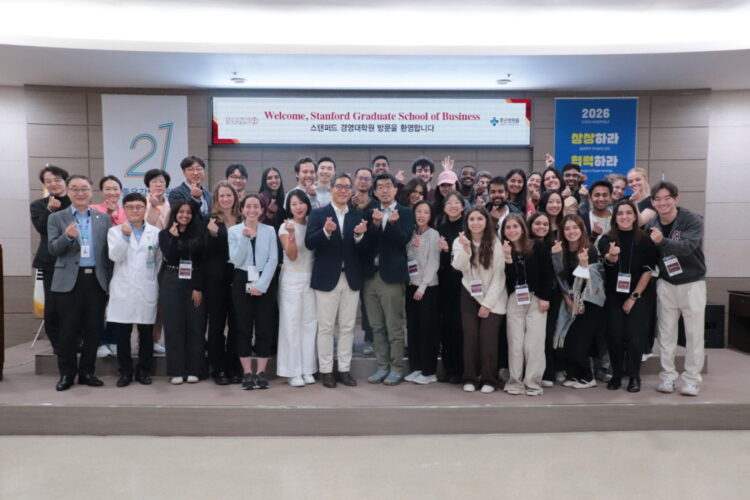
For them, K-healthcare—advancing at a remarkable pace in recent years—is an important area of study. What drew their attention in particular was not so much “which technology was used,” but “how that technology actually works inside a hospital.” For those exploring where future hospital competitiveness lies, they were less interested in simply owning AI tools and more curious about how seamlessly AI is embedded across diagnostic, nursing, administrative, and care-team collaboration systems.
Joeun Gangan Hospital draws attention as a model of ‘execution-focused digital healthcare’
The Joeun Hospitals under the Eunsung Medical Foundation (including Munhwa, Samseon, and Gangan) explained that they have pursued digital transformation with the goal of becoming an “AI-augmented hospital,” going beyond the mere adoption of digital devices. According to the hospital, starting in 2019 with the chest X-ray interpretation AI “Lunit INSIGHT CXR,” they have sequentially introduced—and used in real clinical care—the breast cancer diagnostic AI “Lunit INSIGHT MMG,” an emergency stroke diagnosis AI (JLK), and VitalCare (AITRICS), a patient deterioration prediction solution.
They have not stopped at adopting technology alone. Recently, they established the “Joeun Hospitals AX Healthcare Center” at Pusan National University, expanding their scope to include AI development and real-world validation. In 2023, they also became the first hospital in Korea to introduce Google Workspace (GWS) to digitize the staff collaboration environment. It is an effort to bring document co-authoring, meeting operations, and internal communication together into a single work environment.
The students also saw how AI diagnostic solutions are used in actual care processes through imaging test demonstrations and inpatient ward tours. Koo Ja-seong, Chairman of the Eunsung Medical Foundation, responded by personally presenting the rationale for adopting AI diagnostic solutions and the current status of their operation.
In the Q&A that followed, the students focused on these “post-adoption issues.” In particular, during the ward tour they showed strong interest in smart systems that monitor and manage patient conditions in real time, as well as the digital environment that connects patient rooms and clinical staff.
In other words, they examined whether the technology goes beyond on-screen demos to change the hospital’s response speed and the way teams collaborate. Student representative Derek Peng said, “It was extremely helpful to hear explanations and experience digital healthcare in the field—something I had only seen in books,” adding, “I want to study this area more going forward.”