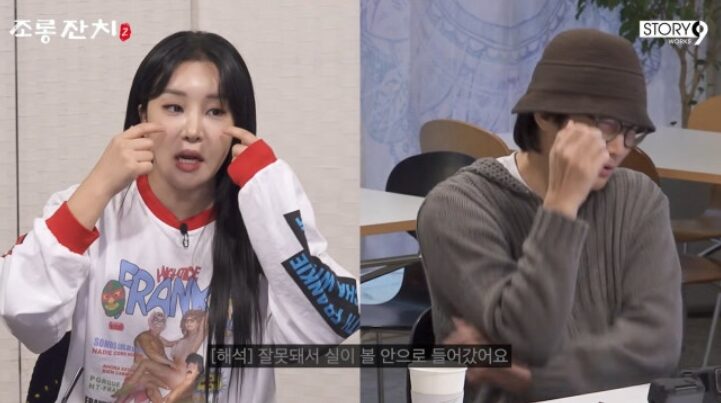
The popular YouTuber and broadcaster Ralral recently revealed that she impulsively removed her own surgical stitches following cosmetic procedures. Ralral, who recently underwent lower eyelid fat repositioning and a nose job, shared the anecdote during a guest appearance on the YouTube channel Lee Yong-jin YouTube in a video titled "39th Ralral Mocking Party 2."
During the episode, Ralral candidly discussed her experiences living with Attention Deficit Hyperactivity Disorder (ADHD). When asked to define the condition, she explained it as "a condition caused by a lack of dopamine." She then surprised the host and viewers by confessing, "I removed my stitches today, even though I wasn't supposed to touch them. I thought the swelling might go down, so I started touching the thread and ended up pulling it out myself."
The situation escalated when she inadvertently pulled a non-dissolvable thread into her cheek. "When I asked the doctor if it was dissolvable, he said it wasn't," Ralral added. "He was surprised, saying it was his first time seeing this situation. When I feel like I want to remove something, I tend to act immediately; it’s hard to suppress my impulses."
The Dangers of Self-Removing Stitches: Infection and Foreign Body Reactions
Following any surgery, it is standard medical practice for staff to remove non-dissolvable sutures at a designated time. Attempting to remove stitches at home, as Ralral did, carries significant clinical risks, primarily the reopening of the wound. Even if the skin surface appears closed, the underlying tissue may not be fully healed. If the area reopens, it may require re-suturing and can lead to more prominent scarring.
The risk of infection also spikes outside of a sterile clinical environment. While hospitals use sterilized instruments, using unsterilized tools or bare hands at home can introduce bacteria into the wound, leading to pain, swelling, and pus.
Furthermore, removing stitches without medical training can lead to sutures being trapped inside the skin. Sutures are often knotted beneath the surface; if a layperson cuts the thread incorrectly, the knot can be pulled deep into the tissue. This may cause a foreign body reaction, leading to internal inflammation or the formation of nodules that might eventually require surgical re-incision to remove.
Managing ADHD Impulsivity Through Therapy and Medication
The impulsivity described by Ralral is a hallmark of ADHD, a condition characterized by the irregular regulation of neurotransmitters like dopamine and norepinephrine in the brain. This neurobiological imbalance often leads to behaviors where individuals feel an uncontrollable urge to act on sudden thoughts or discomfort.
To manage these symptoms, experts often recommend behavioral therapy. One common technique is the "10-minute rule," which encourages patients to wait before acting on an impulse to allow the regulatory parts of the brain to engage.
If behavioral strategies are insufficient, medication may be considered. Treatments that regulate dopamine and norepinephrine signals can effectively alleviate impulsivity and improve concentration. However, any treatment plan should be developed through a detailed consultation with a medical specialist to address the specific needs of the individual.