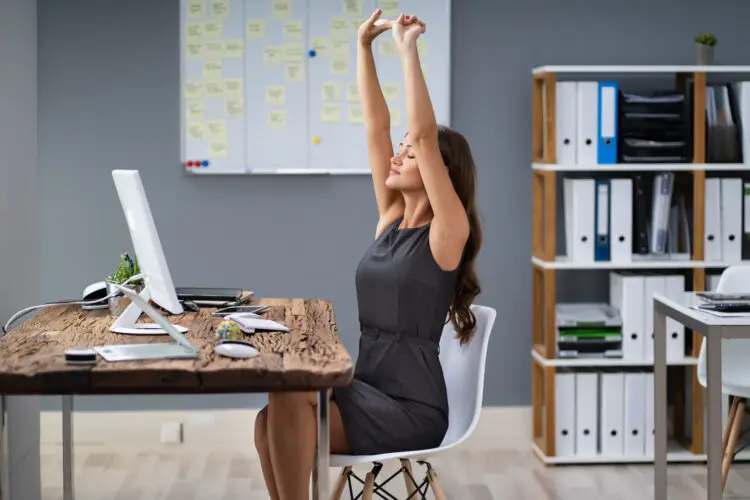
For those who spend most of their workday in front of a desk, the advice to ‘get up and move often’ is not realistic. In an environment filled with meetings, computer work, and deadlines, sitting for long periods is more of a necessity than a choice. The problem is not just the act of sitting, but the fact that your body remains almost completely still during that time. If you have to sit for long hours, it’s time to find ways to keep your body active rather than blaming your posture.
The Problem is Not the Chair, but the ‘Stationary State’
Sitting for long periods drastically reduces the use of lower body muscles, especially the glutes and thigh muscles. This leads to a decrease in blood circulation and energy metabolism. The burden naturally shifts to the back, neck, and shoulders. By the afternoon, your back becomes stiff, your shoulders feel heavy, and your concentration drops sharply. Many people say, “I exercise, so why do I still feel uncomfortable?” but the issue lies in how long your body has been stationary compared to the one hour of exercise. It’s not the chair, but the stationary state that damages your body.
‘Continuous Sitting Time’ is More Dangerous
Recently, the focus of health management has shifted from the total time spent sitting each day to how long you sit at one time. When you remain fixed in the same position for one or two hours or more, your muscles stiffen and your blood vessels are compressed. If this state is repeated, back pain, neck pain, and lower body swelling can easily become part of your daily life. A realistic solution is to give your body a signal every 30 to 60 minutes. If it’s difficult to get up from your seat, incorporating movement while sitting becomes a practical survival strategy.
Possible ‘Revitalizing Movements’ While Sitting
Raising and lowering your heels while sitting is the simplest way to stimulate lower body blood flow. Just slowly rotating your ankles can awaken your calf muscles. Moving your hips to the edge of the chair and straightening your back while tightening your abdomen for 10 seconds activates your core muscles. Raising your shoulders towards your ears and then relaxing them helps relieve tension in your neck and trapezius muscles. All these movements provide clear stimulation to your body without disrupting your workflow.
When You Move While Sitting, Fatigue Changes
These small movements cannot replace the exercises done at the gym. However, they definitely slow down the rate at which your body deteriorates. This is why people who used to feel heavy legs and stiff backs in the afternoon now feel ‘less stiff than before.’ There are also many cases where the phenomenon of blood sugar spiking and dropping sharply or lower body swelling is alleviated. It’s not necessary to have large, noticeable movements. What matters is the frequency of movement, not the intensity. Those who move frequently, even if the movements are small, ultimately maintain their daily condition.
If You Have to Sit for Long Periods, Endure Like This!
Changing the work environment overnight is not easy. Therefore, the choice is clear. Acknowledge the reality of sitting for long periods, but continue to awaken your body within that reality. Small movements in your chair are not trivial habits; they are the minimum survival method for those who work long hours sitting down. If you cannot sit less, you must move while sitting. This means incorporating light upper body stretches like neck and shoulder rotations while gradually adding lower body movements to change your posture. This is the common strategy of those who endure for long periods.