“Doctor, what exactly is a hospitalist?”
When the hospitalist system was first launched in Korea in 2016 as a pilot program, ward patients would tilt their heads and ask this. Each time, I would answer like this.
“It refers to a physician who does not provide outpatient care and instead specializes in caring only for hospitalized patients. It’s the ward’s primary attending physician who is responsible for the entire process from admission to discharge. When needed during hospitalization, we also coordinate by contacting subspecialists so patients can receive specialized treatment or surgery.”
At the time, patients admitted to university hospitals often found it difficult to see a doctor except for one or two professor rounds a day. Residents in training were also overwhelmed with excessive workloads, so it was not enough to ease patients’ discomfort or caregivers’ anxiety.
That is why the hospitalist system was introduced—to have attending physicians stationed on the ward who continuously monitor patients’ conditions and respond immediately, reducing risks caused by a “lack of doctors.” In advanced countries such as the United States and Japan, it began 20–30 years ago and has long since become established.
In English, an inpatient-dedicated physician is called a hospitalist. In other words, it means a doctor who stays in the hospital. When I introduced myself as a hospitalist, patients or caregivers would ask back, “A hospice doctor?” Hospice refers to caring for terminally ill patients, so some patients would wonder why they were receiving hospice care. The hospitalist system was that unfamiliar—and that groundbreaking.
Before I knew it, 10 years had passed. In the meantime, large hospitals began actively using hospitalists while promoting themselves as “specialist-centered hospitals,” and the government encouraged the system by providing incentives to tertiary hospitals that employ hospitalists. When a healthcare vacuum occurred due to the mass resignation of residents the year before last, hospitals with hospitalists were able to provide inpatient care relatively stably.
The ward landscape has changed, too. The phrase I hear most often from patients is surprisingly simple.
“It puts my mind at ease because you’re always nearby on the ward.”
Checking symptoms day by day, explaining test results, and carefully walking patients through the treatment plan ahead—this process may seem obvious, but for patients and caregivers it builds trust that “someone is always here taking care of me.” Each time, I feel proud of myself for choosing this work.
When I work weekends, the scenes I encounter on the ward are a bit different. That’s because I care not only for my own patients but also for the patients of my colleague physicians who work with me on weekdays. Before the weekend, I receive updates on patients’ conditions from my colleagues and then check, one by one, everything that happened over the weekend.
“Hello. I’m the attending physician on call today, so I came by to see how you’re doing.”
At first, both patients and caregivers are briefly taken aback by a visit from an unfamiliar doctor. But as I ask about their condition and continue explaining calmly, their expressions soon brighten. And by the time I’m about to leave after rounds, I hear, “Thank you for coming even though it’s the weekend and for taking such thorough care of me, just like my primary doctor.” It’s a single sentence that melts away the fatigue of weekend call.
In that moment, I once again feel the reason hospitalists exist. I realize that the essence of our work is the sense of responsibility and pride in guarding the ward so that medical care does not stop—regardless of day or night, weekday or holiday—and so that patients’ safety is not compromised.
Currently, about 360 hospitalists are working at medical institutions nationwide. Considering the scale of our healthcare system, that number is nowhere near enough. A couple of years ago, the Korea Patient Organization Alliance asked about 1,000 patients about the hospitalist system; respondents said satisfaction was high but awareness was low. Because there are so few hospitalists, many patients do not know the system well, but among those who have received care even once, more than 8 out of 10 said they would want to be treated by a hospitalist again. It seems to be slowly taking root as a truly necessary role.
It may sound like a funny aside, but there’s one more thing patients genuinely don’t realize.
The goal of a hospitalist is to help hospitalized patients recover their health so they can return to everyday life and be discharged. Meeting us—who work only on the ward—means that someone’s condition worsened again and they were hospitalized. So when patients are discharged, conversations like this happen.
“Thanks to you, Doctor, I’m feeling better. I’ll definitely see you again next time.”
“It’s better if you don’t see me. Take good care of your health after discharge, and you must not be hospitalized again. Let’s never meet again.”
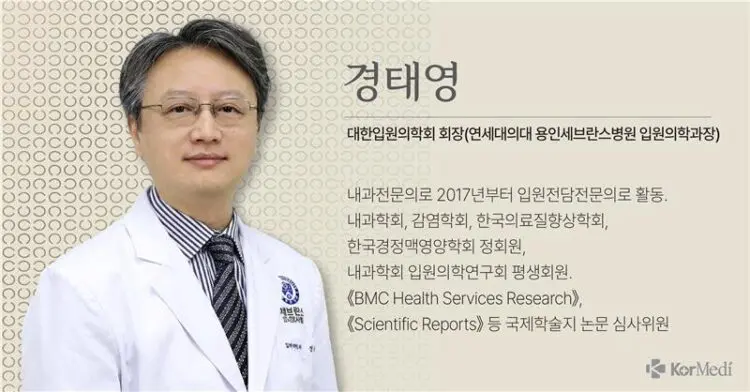
Kyong Tae-young, MD
President, Korean Society of Hospital Medicine (Chair, Department of Hospital Medicine, Yongin Severance Hospital, Yonsei University College of Medicine)
〈Editor’s Note〉
A hospitalist is a physician who stays on the ward and cares for hospitalized patients at close range. The hospitalist system, which began as a pilot program in 2016, was converted into a full program in 2021 and marks its 10th year this year. “Hospitalist Diary” is a record of the small moments these physicians accumulate day by day as they meet patients on the ward, treat them, and discharge them. From patients and caregivers to other medical staff—and even the hospitalists’ own candid reflections—this series aims to share with readers the “human stories” lived inside the hospital. With support from the Korean Society of Hospital Medicine.