There may be people who have experienced a foggy head, decreased concentration, or temporary memory loss after being infected with the COVID-19 virus. It has been revealed that such symptoms are not just due to mood but are scientifically grounded aftereffects.
On the 10th, the National Institute of Health Research of the Disease Control Agency announced that it has scientifically identified the causes of cognitive impairments such as decreased concentration and memory reported after COVID-19 infection through animal experiments.
As a result of administering the spike protein (S1) of the COVID-19 virus to experimental mice, it was observed that the time taken to find hidden platforms increased, indicating a decrease in learning and memory abilities, along with an increase in anxious behavior. This resembles the cognitive decline observed after COVID-19 infection. The researchers analyzed that S1 reaches the brain, disrupts connections between nerve cells (synapses), and reduces the expression of genes important for memory formation, such as NMDA receptors.
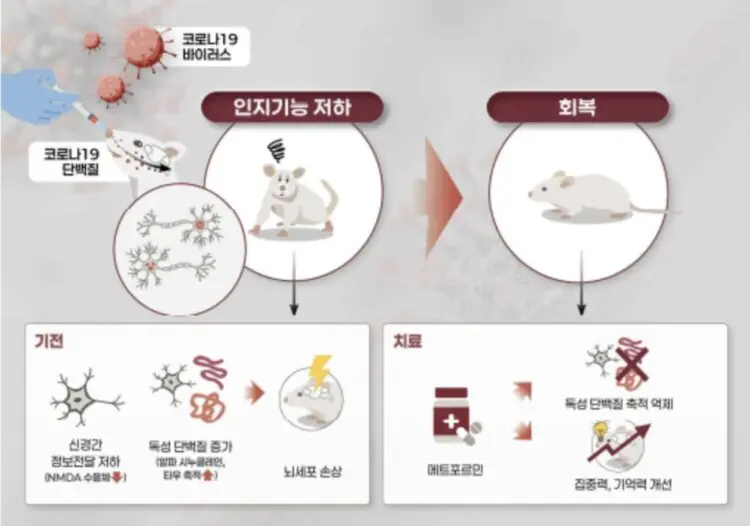
Experimental mice that received S1 showed a decrease in the number of nerve cells in the brain (hippocampus) after 6 weeks. Additionally, toxic proteins related to dementia and Parkinson's disease, 'tau' and 'alpha-synuclein', were confirmed to have accumulated. Based on this, the researchers raised the possibility that S1 could cause long-term brain damage.
However, when the diabetes medication 'Metformin' was administered to the experimental mice under the same conditions, the researchers observed a recovery in nerve cell function and a reduction in the accumulation of toxic proteins. Metformin is a commonly used oral medication for the treatment of type 2 diabetes.
The National Institute of Health Research stated, "Through this study, we have clarified the causes of cognitive impairments that occur after contracting COVID-19 and confirmed the possibility that Metformin, which is widely used in actual clinical settings, may help reduce these issues."