
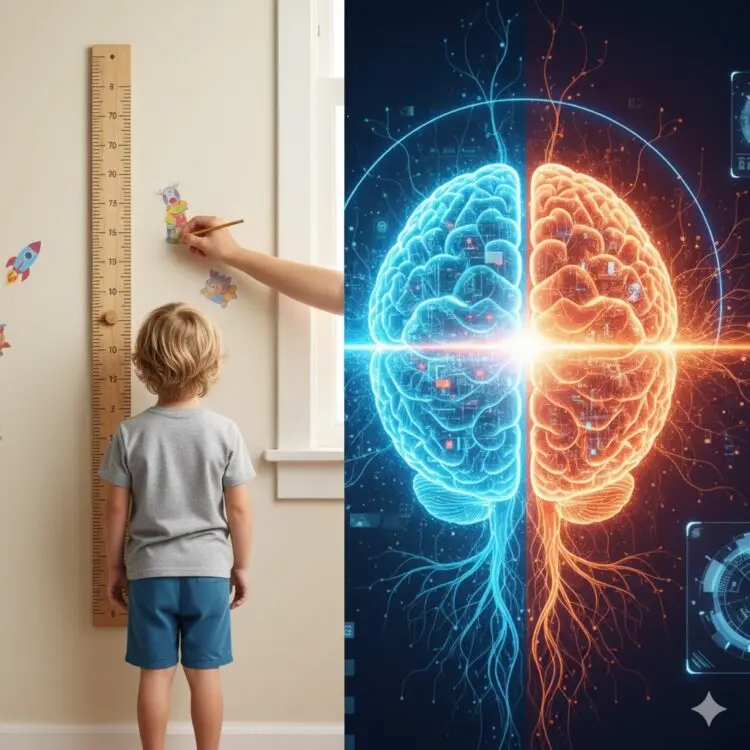
Growth hormone, long known for increasing height and supporting physical growth, has now been found to play a crucial role in forming memories in the brain. At the moment we learn something, growth hormone rapidly increases in the brain, promoting the maturation of neurons that store memories.
A research team led by Director Bong-gyun Kang of the Memory and Glia Research Group at the Institute for Basic Science (IBS) reported that they confirmed these findings in mouse experiments. The study was published on the 20th in the international journal 〈Science Advances〉.
The team trained mice to recognize a specific environment as dangerous, then administered a drug that inhibits protein synthesis at different time points relative to the learning session. They then compared memory formation and recall by observing the mice’s responses when re-exposed to the same environment.
The results showed that blocking protein synthesis after learning ended preserved memory recall, but blocking protein synthesis at the moment learning occurred and immediately afterward significantly reduced recall. Synaptic changes that strengthen connections between neurons in memory-storing cells also did not appear. This suggests that proteins required for memory formation must be synthesized within a very short window early in learning.
When the brain has a particular experience, only some neurons are selectively activated and store the memory; scientists call these “memory engram cells.” For these cells to properly store memories and retrieve them later, they must undergo a “maturation” process in which their structure and function change. However, exactly when this maturation begins and how it is regulated had not been clearly identified.
Among the proteins produced immediately after learning, the team focused on growth hormone. Growth hormone rapidly increased in the hippocampus after learning, and it appeared selectively only in neurons activated during the learning process.
To confirm whether growth hormone is truly involved in memory formation, the researchers conducted additional experiments. When they disrupted growth hormone signaling in mice, synaptic changes in memory engram cells did not occur, and memory recall behavior decreased.
Conversely, when growth hormone was administered externally in a state where protein synthesis was inhibited and memory formation was impaired, changes in memory engram cells partially recovered, and behavior reflecting recall of what was learned also returned.

Director Bong-gyun Kang said, “Until now, the process of memory formation has mainly been studied with a focus on neurotransmitters and synaptic changes,” adding, “This study showed that growth hormone, known as a regulator of physical growth, can directly control functional changes in memory engram cells.”
This discovery is expected to open new possibilities for treating brain disorders such as dementia and age-related memory decline.