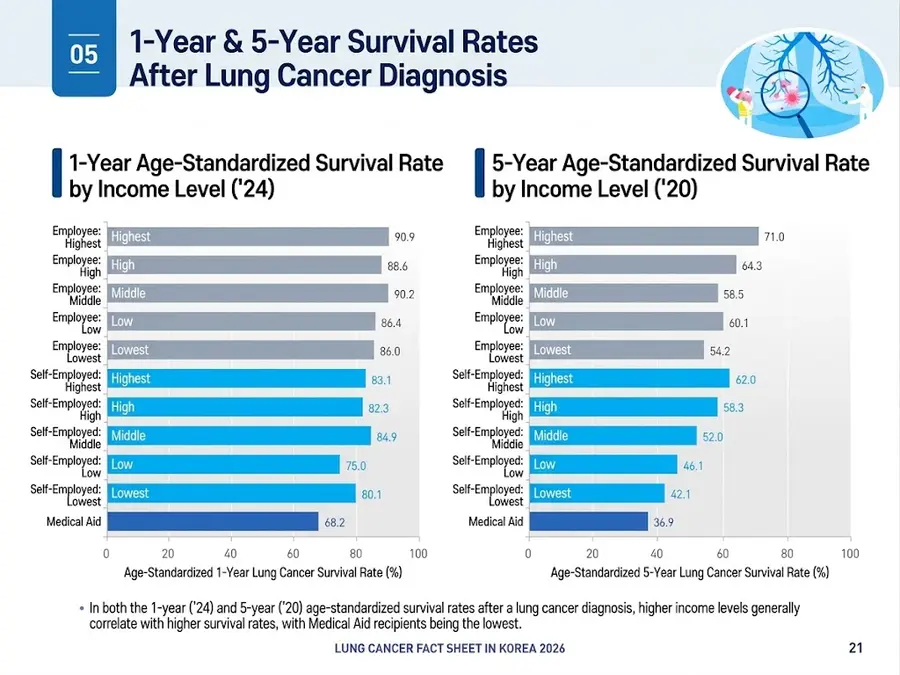
While advancements in lung cancer treatment have steadily boosted overall survival rates in South Korea, a substantial gap persists based on patients' economic status. The five-year survival rate for lung cancer patients receiving Medical Aid benefits stands at just 36.9%, compared with 71.0% among the highest-income employee-insured group—a 34.1 percentage-point disparity.
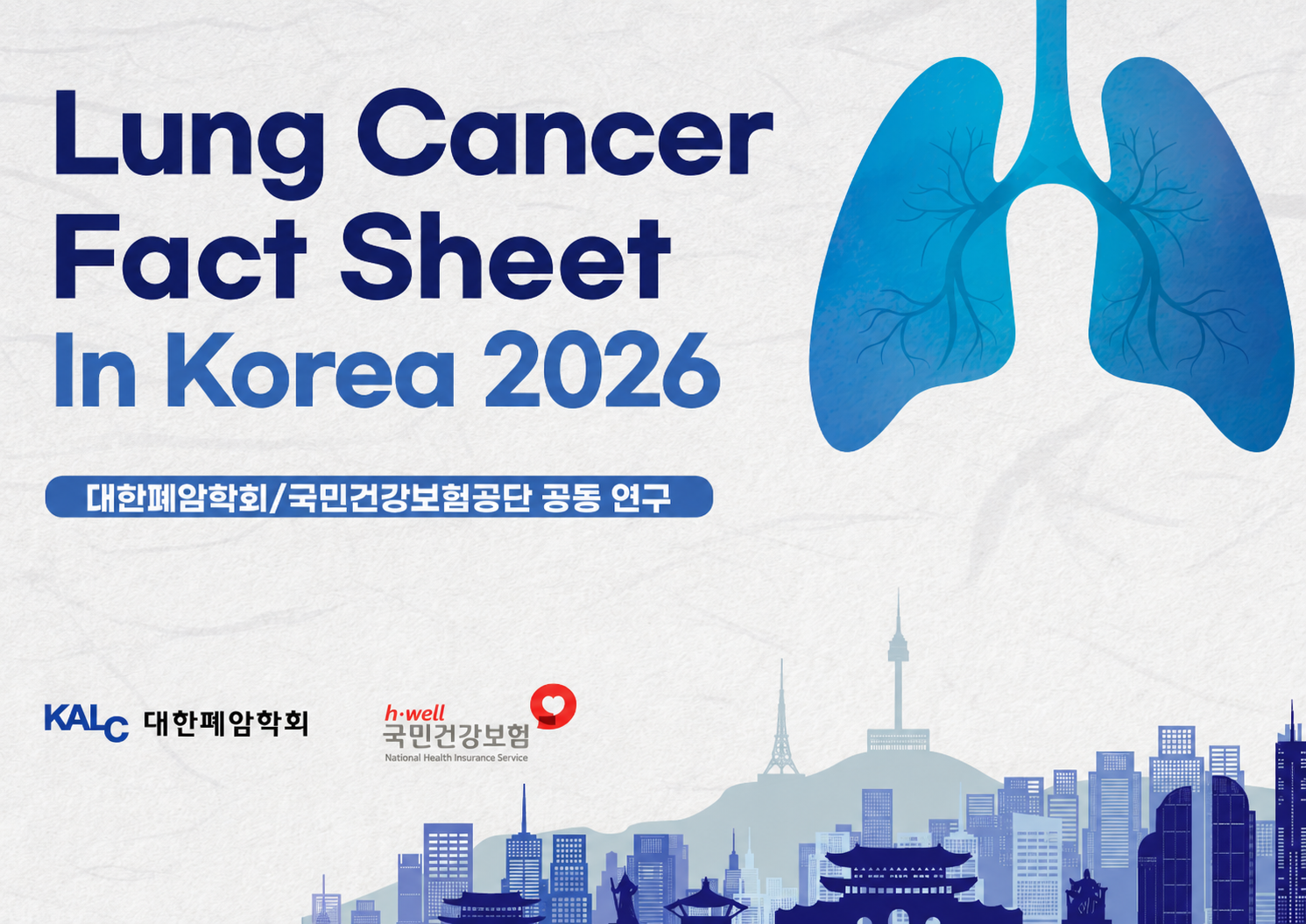
The National Health Insurance Service (NHIS), led by President Kang Cheong-hee, and the Korean Association for Lung Cancer, led by President Woo Hong-gyun, jointly published the 2026 Lung Cancer Fact Sheet in Korea on Oct. 15. Based on national health insurance big data, the publication marks the second edition of the report and analyzes lung cancer incidence, treatment trends, and survival outcomes across an 18-year period from 2008 to 2025. This year's edition incorporates regional and income-based disparities for the first time.
Socioeconomic disparities were also reflected in lung cancer incidence rates. In 2025, the age-standardized incidence rate among Medical Aid beneficiaries was the highest at 81.1 cases per 100,000 people. By comparison, the rate was 57.5 cases per 100,000 for upper-income self-employed subscribers and 58.7 cases for the highest-income employee-insured group. The incidence rate among Medical Aid beneficiaries was roughly 41% higher than that of upper-income self-employed subscribers.
Geographically, lung cancer incidence was relatively higher in rural areas. The age-standardized incidence rates per 100,000 people were 61.7 in metropolitan areas, 62.1 in small and medium-sized cities, and 65.6 in rural regions. Age-standardized incidence is a statistical metric that adjusts for age distribution differences across regional populations.
However, researchers noted that income level or geographic location cannot be viewed as direct causes of these disparities. Multiple interacting factors likely play a role, including smoking history, occupational and environmental exposures, disease stage at diagnosis, underlying comorbidities, and differences in healthcare access.
The absolute number of newly diagnosed lung cancer cases continued an upward trajectory. In 2025, a total of 32,926 individuals were newly diagnosed with lung cancer—comprising 21,488 men and 11,438 women. Patients aged 60 to 79 represented 67.1% of all new diagnoses.
Conversely, after adjusting for population aging, the underlying incidence rate actually declined. The age-standardized incidence rate per 100,000 people fell from 67.3 in 2008 to 64.4 in 2020, and further down to 62.1 in 2025. Although the total number of patients grew alongside the expanding elderly demographic, the rate per capita adjusted for age decreased.
Treatment approaches have also evolved over time. The proportion of patients undergoing surgery within one year of diagnosis rose from 22.7% in 2008 to 39.2% in 2025, an increase of 16.5 percentage points. Similarly, the proportion of patients receiving surgical intervention alone, without combining it with other therapies, increased from 17.9% to 33.2% over the same period.
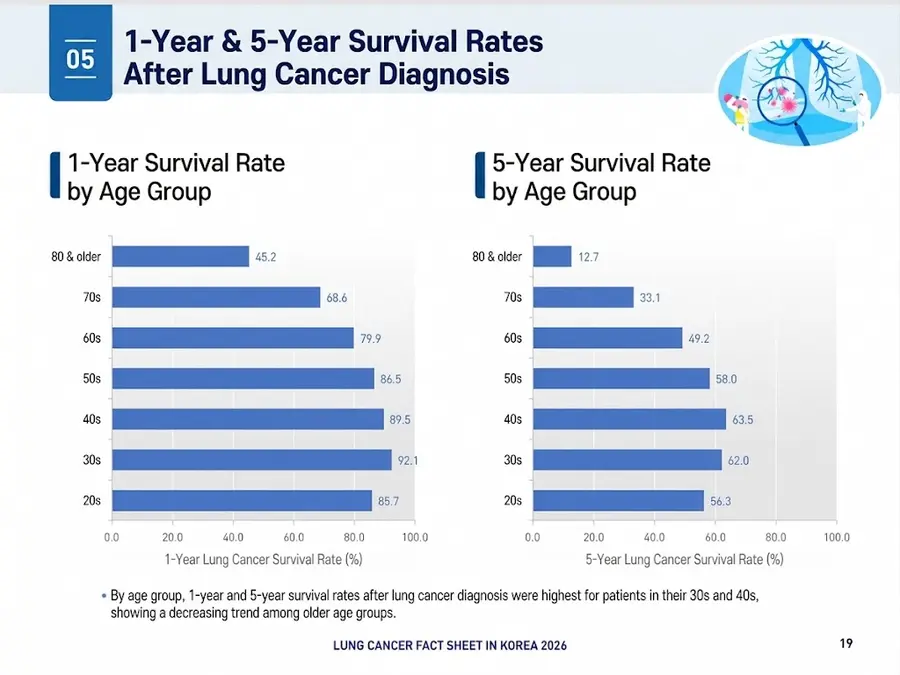
Overall survival metrics demonstrated significant progress. The one-year survival rate following a lung cancer diagnosis climbed from 48.8% in 2008 to 70.3% in 2024. The five-year survival rate more than doubled, rising from 18.7% in 2008 to 38.4% in 2020. Because calculating five-year survival requires long-term post-diagnostic follow-up, its tracking period differs from that of the one-year survival rate.
The Korean Association for Lung Cancer attributed these survival gains primarily to early detection through national lung cancer screening programs, advancements in surgical techniques and radiation therapy, and the introduction of targeted therapies and immunotherapies. However, researchers noted that available data cannot isolate the exact contribution of each individual treatment modality.
Beyond highlighting clinical progress, the fact sheet emphasized the necessity of addressing underlying health inequities.
In the foreword, NHIS President Kang Cheong-hee emphasized the importance of tracking disease trends through accurate empirical data and systematically analyzing health disparities linked to socioeconomic status and region.
Woo Hong-gyun, president of the Korean Association for Lung Cancer, expressed hope that the fact sheet would serve as a crucial evidentiary foundation for formulating national policies across lung cancer prevention, early screening, treatment, and long-term care management.
Moving forward, both organizations plan to leverage these findings to heighten public awareness regarding lung cancer prevention and early screening, while actively supporting policy initiatives designed to bridge regional and income-based health disparities.