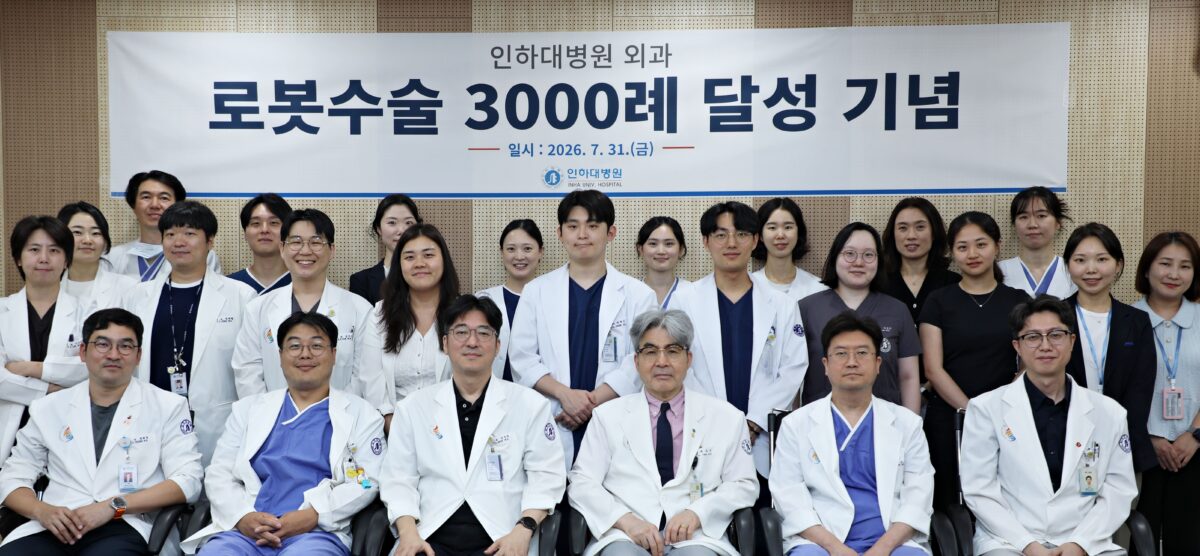
Inha University Hospital's department of surgery has performed more than 3,000 cumulative robot-assisted procedures. Beyond thyroid cancer, the department is actively expanding the use of single-port robotic surgery—performed through a single incision—to include colon cancer and breast cancer, as well as procedures such as gallbladder and adrenal gland removal.
The hospital announced on August 7 that its surgery department officially reached the 3,000-case milestone as of July 31. The department began offering robotic surgery in December 2018 with the opening of its Robotic Surgery Center. It reached 1,000 cumulative cases in 2022 and 2,000 cases in 2024 before surpassing 3,000 cases in July.
Multi-Port and Single-Port Systems Drive Surgical Expansion
The hospital currently operates three surgical robot systems: one da Vinci Xi, which uses multiple small incisions, and two single-port da Vinci SP systems, which insert a camera and surgical instruments through a single incision. In robotic surgery, the operating surgeon sits at a console, directly controlling robotic arms and specialized instruments while viewing a high-definition screen.
Inha University Hospital introduced the first da Vinci SP system in the Incheon region in December 2022. To meet rising patient demand, it added a second SP system late last year.
Within general surgery, single-port procedures are now utilized for thyroid, colon, and breast cancers, as well as spleen and gallbladder removals. For thyroid cancer, surgeons frequently employ an approach through the natural crease of the armpit, avoiding a visible incision scar on the neck. The hospital noted that it has recorded five regional firsts in Incheon for single-port da Vinci SP operations, including procedures for colon cancer, breast cancer, hernias, adrenal glands, and gallbladder removal.
While single-port surgery reduces incision size, post-operative pain, and recovery times, surgeons select between single-port and multi-port approaches after evaluating the specific disease, stage, surgical site, and patient anatomy.
Center-Wide Cases Exceed 5,000 Across Six Departments
Across the entire Robotic Surgery Center—which encompasses surgery, urology, obstetrics and gynecology, cardiothoracic surgery, otolaryngology, and pulmonology—the hospital has surpassed 5,000 cumulative procedures. In addition to its three da Vinci surgical systems, the center operates "Ion," a robotic-assisted bronchoscopy platform used for lung biopsies, and "Hub," a remote media platform for robotic surgery.
"Reaching 3,000 cases in nearly eight years since our first procedure in 2018 reflects growing patient trust and satisfaction in robotic surgery," said Shin Woo-young, head of the surgery department at Inha University Hospital. "We will continue to broaden the application of robotic procedures with a commitment to safety and precision, providing patients with a wider array of customized treatment options."