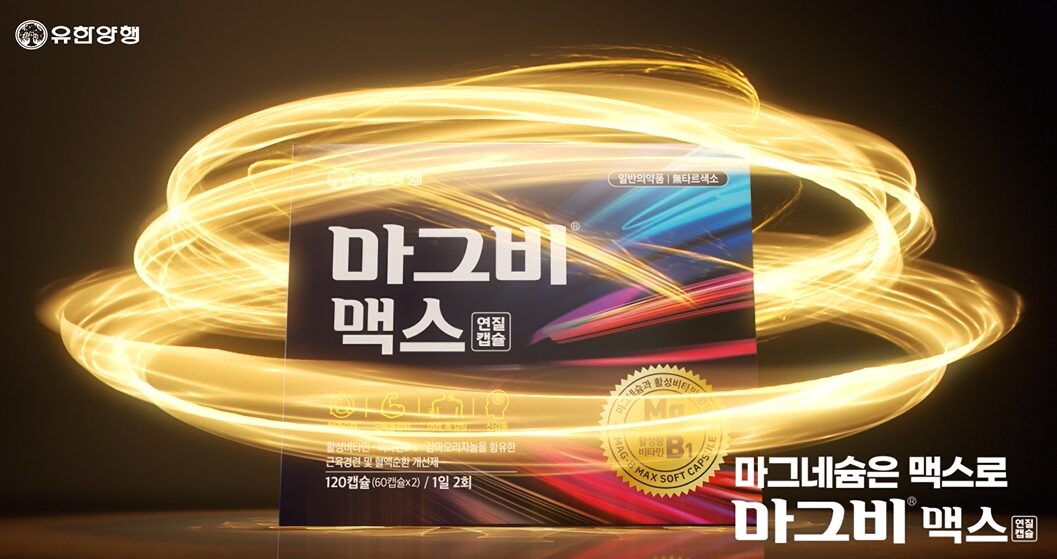
If your lower eyelid twitches or you experience sudden leg cramps, it is common to assume a magnesium deficiency is to blame. Capitalizing on growing consumer interest, Yuhan Corp. is expanding its presence in the over-the-counter (OTC) magnesium market by aggressively marketing both a liquid formulation and high-dose capsules.
Yuhan announced on July 29 that it has launched an integrated brand campaign for its MagV lineup, releasing a new commercial for "MagV Max" alongside existing advertisements for "MagV Speed." The marketing push spans cable television, the video-streaming platform TVING, digital media, and outdoor billboards in major metropolitan areas across South Korea, featuring actor Kwak Si-yang as the official brand model.
Built around the key slogans "When you need MagV Speed" and "When you need MagV Max," the campaign illustrates specific daily scenarios tailored to each product formulation. Using this dual-marketing strategy as a springboard, Yuhan has established an ambitious sales target of 30 billion won for the MagV brand this year.
Formulations, Chemical Properties, and Approved Indications
MagV Max is an OTC pharmaceutical combining magnesium with B vitamins, vitamin E, and other supportive nutrients in a single softgel capsule. Each capsule contains 350 mg of magnesium oxide, providing approximately 211 mg of elemental magnesium. The recommended dosage for adults and adolescents aged 12 and older is one capsule twice daily.
Beyond its primary indication for treating muscle cramps caused by magnesium deficiency, its approved uses—attributed to its multi-vitamin complex—include relief from physical fatigue, vitamin supplementation during old age, stiff shoulders and neck, numbness and coldness in the hands and feet, as well as neuralgia and general muscle pain.
In contrast, MagV Speed is a liquid formulation containing 1,200 mg of magnesium glycerophosphate per 20 mL bottle, delivering 150 mg of elemental magnesium alongside vitamins B2 and B6. Designed for adults and adolescents aged 12 and older, the recommended dose is one bottle twice daily. The liquid format caters to individuals who experience difficulty swallowing solid capsules, offering the convenience of direct consumption without water or the option to dilute it in a small amount of liquid.
The two products utilize fundamental differences in chemical structure. In pharmaceutical science, a "salt" refers to an ionic compound composed of cations and anions, such as sodium chloride. In MagV Speed, magnesium is bound to glycerophosphate, whereas MagV Max utilizes magnesium oxide, where magnesium is bound to oxygen.
Chemical structure directly dictates water solubility and systemic absorption rates; generally, magnesium compounds that dissolve readily in water demonstrate higher absorption efficiency in the gastrointestinal tract. Consequently, Yuhan’s advertising highlights fast absorption and portable convenience for liquid MagV Speed, while framing MagV Max around maximum potency with the slogan, "For magnesium, go max — MagV Max."
Clinical Reality, Risk Factors, and Drug Interactions
Although commercials for MagV Max depict common physical complaints such as leg cramps, hand and foot numbness, eyelid twitching, and physical fatigue, medical professionals emphasize that eyelid twitching does not automatically signify a magnesium deficiency. The symptom frequently stems from fatigue, sleep deprivation, psychological stress, or excessive consumption of caffeine and alcohol.
If twitching persists for more than two weeks despite adequate rest and lifestyle modifications, or if spasms spread to other facial muscles, patients should consult a physician for a comprehensive diagnostic evaluation.
Magnesium supplementation also requires careful consideration based on individual health status and concurrent drug regimens. Because excess systemic magnesium is primarily excreted through the kidneys, patients with compromised renal function face a heightened risk of magnesium accumulation and toxicity.
MagV Max is strictly contraindicated for individuals with severe renal failure. Patients with mild-to-moderate kidney impairment, cardiac disorders, circulatory dysfunction, or those who are pregnant or breastfeeding should consult a doctor or pharmacist prior to use.
Furthermore, potential drug interactions must be thoroughly reviewed. MagV Max’s approved labeling warns against co-administration with phosphates, calcium salts, oral tetracycline antibiotics, antacids, or levodopa, a medication used in Parkinson’s disease therapy. Because the softgel contains soybean oil, it is contraindicated for individuals with allergies to soybean oil, soybeans, or peanuts. Consumers taking other magnesium products or multivitamin supplements should verify total daily dosages with a pharmacist to avoid overlapping ingredients.
If adverse reactions such as diarrhea, stomach discomfort, nausea, or skin rashes occur, or if symptoms fail to improve after one month of continuous use, treatment should be discontinued immediately.
"This integrated campaign was developed to effectively communicate the versatile healthcare solutions offered by the MagV brand by simultaneously promoting both the liquid and softgel capsule lines," a Yuhan official stated. Originally launched in 2013, the MagV brand consists exclusively of regulated over-the-counter pharmaceuticals available at retail pharmacies, rather than general dietary or health functional foods.