The most anxious moments for hospitalized patients and their caregivers often occur when medical staff leave the room. Between scheduled nursing rounds and physician checks, a patient’s condition can deteriorate rapidly without immediate notice. Driven by a mission to eliminate these critical gaps in care, Hanyang University Hospital has implemented an artificial intelligence (AI)-based patient monitoring system across all of its general-ward beds.
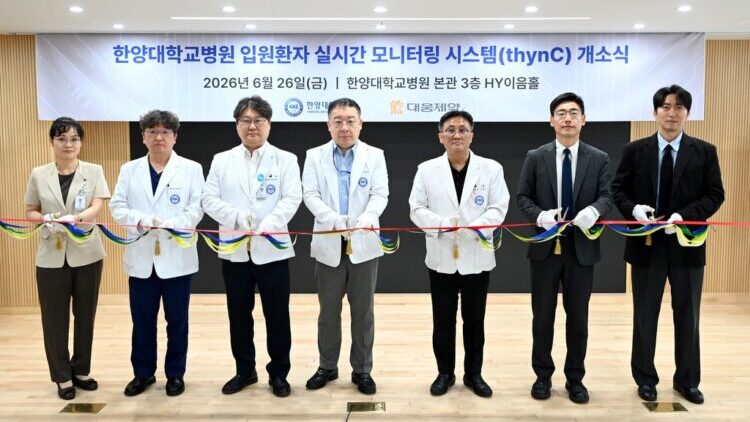
The hospital announced on the 29th that it completed the deployment of "thynC," a smart bedside monitoring system, across all general-ward beds (excluding specialized units) in partnership with Daewoong Pharmaceutical. Following an opening ceremony at the HY Ieum Hall in the hospital's main building, the system is now fully operational.
Developed by Seers Technology, thynC utilizes non-invasive wearable sensors to continuously track a patient’s primary vital signs, including electrocardiograms (ECG), heart rate, respiratory rate, and oxygen saturation. The system analyzes this continuous data stream in real time using AI algorithms. If an anomaly is detected, the system immediately alerts medical staff, facilitating a rapid clinical response.
Bridging the Gap in General Care
Traditionally, general wards have relied on clinicians checking and manually recording patient vitals at fixed intervals. While direct, in-person observations by medical staff remain the gold standard of care, subtle physiological shifts that occur between these check-ins can easily go unnoticed. Continuous, around-the-clock digital monitoring is designed to bridge this precise vulnerability.
For patients, the technology elevates general-ward safety to a level previously reserved for intensive care units (ICUs). For elderly patients or individuals with complex underlying conditions, minor shifts in respiratory rate and oxygen saturation are frequently the earliest indicators of impending medical crises. Detecting these minute changes early allows clinical interventions to begin hours sooner.
The financial barrier for patients is minimized by South Korea's National Health Insurance program, which provides reimbursement for several core thynC functions, including ECG surveillance, heart-rate tracking, and oxygen-saturation monitoring. Out-of-pocket costs for patients apply within standard national insurance frameworks.
Hospital officials emphasize that the AI does not diagnose illnesses or replace medical professionals. Rather, it serves as an advanced safety net—helping clinicians identify subtle physiological changes earlier, prompt in-person evaluations, and accelerate clinical decision-making.
A Shift Toward Proactive Patient Safety
The deployment marks a broader evolution in how healthcare institutions leverage artificial intelligence. Rather than being confined to medical imaging interpretation or diagnostic assistance, AI is increasingly moving into real-time patient safety management on active wards. Because tertiary general hospitals treat a high share of severely ill patients, broadening the safety net in standard rooms has become a critical priority. With Hanyang University Hospital’s adoption, 15 out of the nation’s 47 tertiary general hospitals have now implemented the thynC system.
The technology also integrates directly with the hospital information system (HIS). Automatically recording and logging vital signs eliminates a significant amount of manual data entry for the nursing staff. By alleviating the burden of repetitive administrative documentation, clinicians can dedicate more time to direct patient observation and nuanced clinical judgment.
However, widespread adoption introduces distinct clinical challenges. If thresholds are set too low, excessive alerts can lead to "alarm fatigue," causing clinicians to become desensitized to warnings; conversely, if thresholds are too high, critical clinical events could be missed. Optimizing alert accuracy and prioritizing notifications based on individual patient baselines remain ongoing priorities for hospital medical teams.
Furthermore, managing data privacy is paramount. Because wearable sensors collect sensitive biometric data 24 hours a day, rigorous data-governance and privacy protocols are essential. Hospitals must also maintain transparent communication with patients and families, ensuring they understand that the AI functions as an assistive tool rather than an independent diagnostic authority.

"The introduction of thynC is a core milestone in our smart-hospital strategy to fundamentally strengthen patient safety," said Lee Hyung-joong, president of Hanyang University Hospital. "We will continue to actively adopt advanced digital medical technologies to provide safer, higher-quality, patient-centered medical services."
Lee Chang-jae, CEO of Daewoong Pharmaceutical, added, "Hanyang University Hospital’s implementation is a benchmark showing that AI monitoring systems at major tertiary hospitals can simultaneously elevate patient safety and clinical efficiency. We look forward to expanding the reach of thynC through ongoing collaborations across diverse medical institutions."