Luxury brand Chanel has drawn intense global attention after unveiling a bold, unconventional “half shoe” that dares to eliminate the sole altogether.
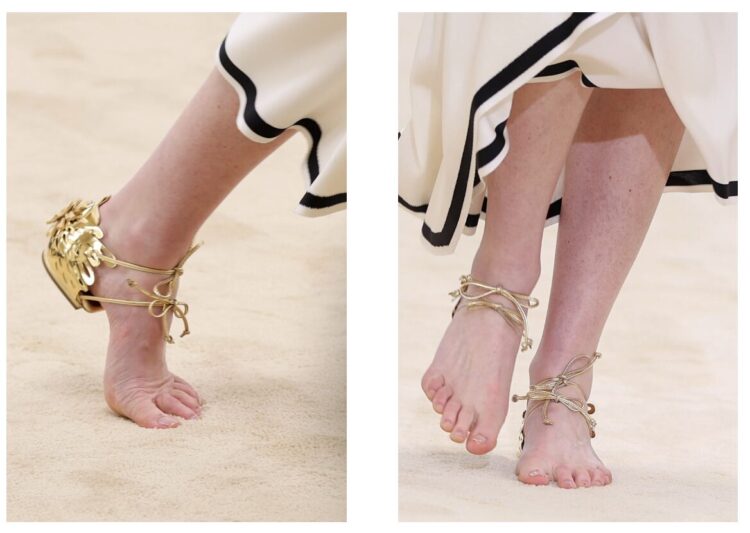
At the 2026–2027 Cruise Collection recently held in Biarritz, France, Chanel revealed a shoe that removes the sole entirely, leaving only a heel to support the back of the foot and a strap to secure the ankle. According to Chanel’s official website, these sandals are scheduled to arrive in boutiques starting in November.
Because the wearer’s foot touches the ground directly, the design—when viewed from the front—makes it appear as if the model is walking barefoot. International fashion outlets have quickly dubbed it the “Naked Shoe,” the “shoe without a shoe,” and even a “heel protector.”
Italy’s NSS Magazine commented that the piece “looks like a design focused on going viral on social media,” and even predicted that a functional sole might be added to the retail version later.
Online, a wave of skepticism has surfaced regarding the design's practicality. Comments range from questioning how anyone could navigate city streets without a sole to describing the item as a heel accessory rather than footwear. Some critics even joked about whether a “half shoe” would come with a 50% price tag.
Chanel’s release of such an unusual silhouette is tied to the current market craze for thin-outsole footwear, often referred to as “low-profile” shoes. Influential figures like Kim Na-young and Kim Jennie have recently popularized "balletcore" sneakers and ultra-flat athletic shoes, driving the demand for minimal soles.
However, medical experts warn that the thin-soled trend may negatively affect foot health.
Flat shoes with little to no heel can feel light and comfortable upon initial wear. However, because they lack a structure that absorbs impact, even a short period of walking can quickly lead to significant fatigue. Without a cushioning layer in the sole, pressure and friction from the pavement are transmitted directly to the bottom of the foot.
In general, walking subjects the body to impact forces of approximately three times one's body weight, while running can impose as much as ten times that weight. If a thin sole cannot absorb this energy properly, the physical burden can extend beyond the ankles to the knees, lower back, and spinal joints.
When this impact accumulates, it can lead to plantar fasciitis—a condition where tiny injuries and inflammation develop in the thick band of tissue on the bottom of the foot. Podiatrists note that conditions causing sole pain, such as plantar fasciitis and Morton’s neuroma, often see a spike in cases following the summer months, largely due to the seasonal popularity of flat, unsupportive footwear.