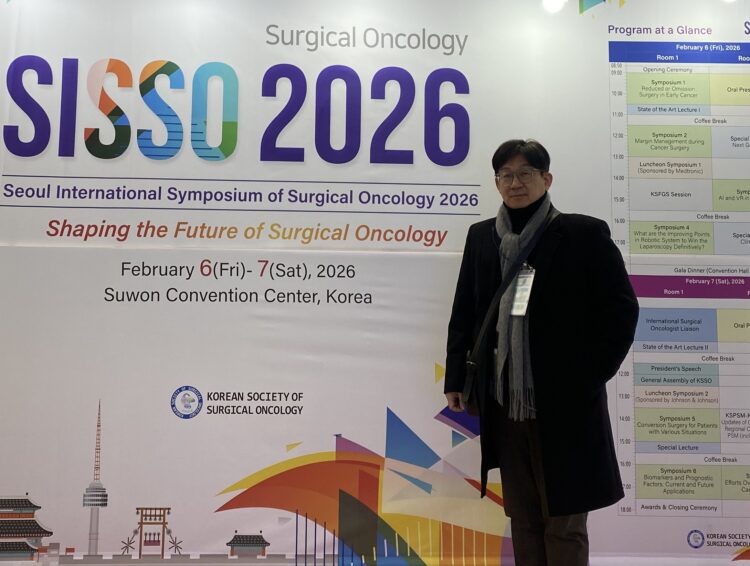

The new drug development platform Pharmulator™ has officially made its debut on the international stage—not at a chemistry lab, but at a major conference for cancer surgeons. The platform was a focal point at the International Symposium of the Korean Society of Surgical Oncology (SISSO) 2026, held on the 6th at the Suwon Convention Center, under the theme "Shaping the Future of Surgical Oncology."
Modern cancer treatment is no longer defined by the scalpel alone. Today, outcomes are determined by a complex synergy of pre- and post-operative targeted therapies, combination therapies, and adjuvant chemotherapy. In this landscape, the question of "which drug to use, and when" has become as critical as the surgery itself.
Quantum-Driven Drug Discovery: Accuracy Over Quantity
Woo Sang-wook, CEO of PharmCADD and a physics professor at Pukyong National University, presented the structural framework and real-world applications of Pharmulator. His presentation, titled "Quantum Advantage-Based Synthetic Drug Discovery," moved beyond theoretical technology to demonstrate how quantum chemistry and quantum calculation are used to engineer and filter high-potential drug candidates.
CEO Woo defined Pharmulator as a precision tool designed to move drugs into clinical settings more safely and rapidly. Crucially, the platform’s philosophy is not about generating a high volume of candidates, but about the "early winnowing" process—identifying and excluding high-risk compounds before they ever reach the expensive experimental stage.
The Pharmulator Edge: AI Design Verified by Physics
The core innovation of Pharmulator is its hybrid approach: combining generative AI with physics-based quantum calculations to eliminate uncertainty.
AI Generation: Generative AI quickly designs potential drug molecules.
Quantum Verification: The platform uses Molecular Dynamics (MD) simulations and quantum chemistry to verify molecular bonding at the electronic level.
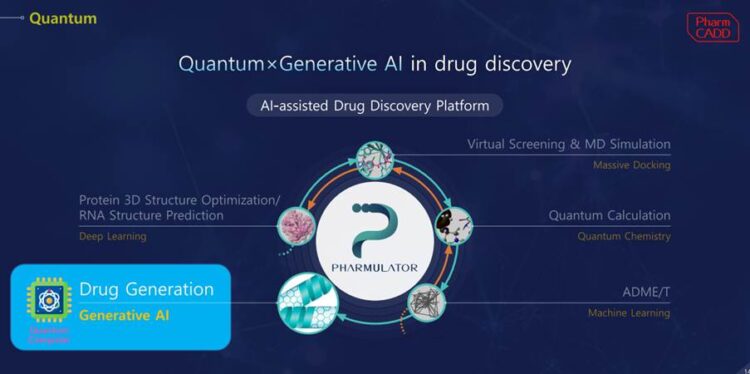
"While AI can generate candidates at high speeds, most clinical failures stem from subtle inaccuracies in molecular bonding," Professor Woo explained. "Quantum calculations allow us to capture these flaws early." Unlike traditional statistical models, this method verifies if a bond is physically stable and feasible.
By using this "quantum filter," candidates showing low bonding stability or high risks of cardiotoxicity (hERG) and hepatotoxicity (DILI) are eliminated immediately. This maximizes the success rate of the substances that eventually proceed to clinical trials.
Why the Surgical Community is Listening
Surgeons are increasingly invested in the clinical reliability of these platforms. During the symposium, interest centered on practical metrics: the extent of candidate verification, the reduction in development timelines, and the reliability of toxicity predictions.
By detailing Pharmulator’s internal data flow and successful case studies, CEO Woo demonstrated that AI and quantum-based platforms are no longer "black boxes" but practical tools for clinical advancement.
The presentation signals a dissolving boundary between surgery, pharmacology, and computational science. As these fields converge, the goal remains singular: bringing faster, safer, and more effective treatments to the operating room and the bedside.