
As our society enters an ultra-aging society, it is expected that the number of patients with 'wet age-related macular degeneration', a representative disease of old age, will surge, highlighting the urgent need for countermeasures.
The ophthalmology team of Professors Woo Se-jun and Kim Min-seok at Seoul National University Bundang Hospital announced on the 9th that, based on an analysis of big data from the National Health Insurance Service, the number of domestic patients with wet macular degeneration is predicted to exceed 370,000 by 2040. This figure is nearly three times the 127,000 patients recorded in 2022.
Macular degeneration is a disease that distorts vision due to damage to the 'macula', the central part of the retina that acts like a film for the eye. Among these, wet macular degeneration is a type where abnormal blood vessels grow within the retina, leaking blood and becoming wet, which progresses rapidly and carries a very high risk of blindness.
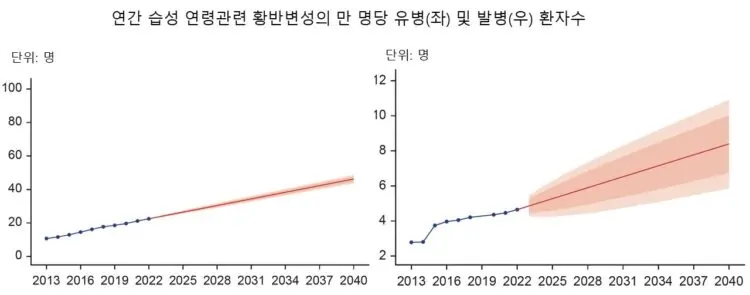
Analyzing trends over a decade from 2013 to 2022, the research team found that the prevalence of wet macular degeneration among the population aged 40 and over increased by 110%, from 10.7 per 10,000 people to 22.5 per 10,000 people. The incidence rate, which indicates the number of newly diagnosed patients during the same period, also surged by 68%, from 2.8 per 10,000 people to 4.7 per 10,000 people.
Even more concerning is the future outlook. Based on time series analysis (a statistical method that predicts future values using past data), the research team predicts that the prevalence of wet macular degeneration will increase to 46.2 per 10,000 people by 2040, more than double the 22.5 per 10,000 people recorded in 2022. The incidence rate is also expected to rise to 8.4 per 10,000 people, an increase of 1.8 times. The cumulative number of patients is expected to surge to approximately 374,000, nearly three times the current level of 127,000 in 2022.
In particular, among the ultra-elderly population aged 80 and over, the prevalence has shown a steady increase of about 10% each year. Considering Korea's population structure, which is experiencing the fastest aging rate in the world, it is anticipated that the number of patients with wet age-related macular degeneration will continue to rise.
Professor Kim Min-seok stated, "This study clearly presents concerns about the increase in national medical expenses and social burdens through long-term trend analysis using reliable data from the National Health Insurance Service to predict the number of patients," and emphasized the need for policy support such as expanding treatment accessibility, improving insurance systems, and strengthening management of the elderly.
Professor Woo Se-jun emphasized, "Wet age-related macular degeneration has a high incidence rate among the elderly and males, and it is a fatal disease that can lead to blindness, making early treatment and management very important to prevent worsening symptoms."
The results of this study were recently published in the international journal 《Journal of Korean Medical Science》 published by the Korean Medical Association.