

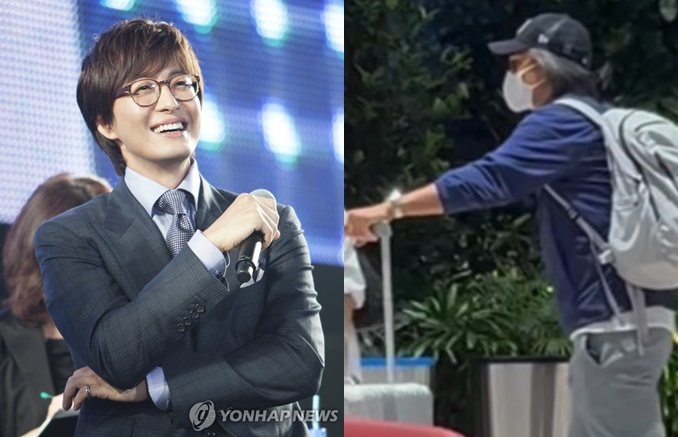
Actor Bae Yong-joon (53) has made a rare public appearance, capturing the public's attention with his naturally graying hair.
On the 8th, the Singaporean media outlet Lianhe Zaobao reported that Bae and his wife, Park Soo-jin (40), were spotted at Singapore Changi Airport alongside close friends and fellow actors Park Shin-hye and Choi Tae-joon. The two couples were reportedly traveling to Singapore for a family vacation with their children.
What drew the most fascination in the circulated photos was Bae’s hairstyle. Dressed casually in a hat, glasses, and a mask, thick silver-and-black strands peeked out from beneath his headwear, with his long hair tied back neatly.
Bae famously ignited the global Korean Wave (Hallyu) boom in Japan through his legendary role in the drama Winter Sonata, single-handedly fueling the historic "Yon-sama" phenomenon. Seeing the passage of time reflected in his naturally graying hair caught fans' eyes, prompting a wave of warm reactions online. Commenters noted, "Gray hair looks fantastic on him," "If I didn't have to cover it up, I'd want to leave mine like that too," "Even with white hair, he is still Yon-sama," and "I’m jealous of how thick his hair remains."
Bae married actress Park Soo-jin, a former member of the K-pop group Sugar, in 2015. The couple has a son and a daughter. They currently reside in Hawaii, where Bae has effectively stepped away from the entertainment industry to focus on business ventures and private investments.
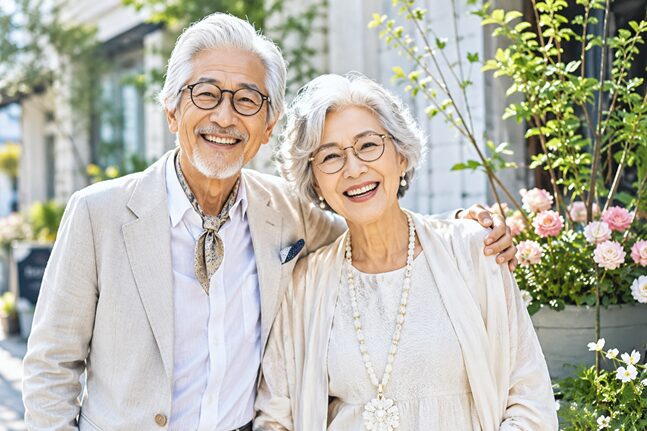
The Rise of 'Going Gray' and Gray Blending
This public buzz highlights an accelerating lifestyle movement known as "Going Gray"—the conscious choice to display silver hair naturally rather than dyeing it. Historically, gray hair was hidden as an unwelcome marker of old age. Recently, however, a broader cultural shift prioritizing natural aging and individuality has taken hold. In South Korea and abroad, high-profile figures displaying their natural hair colors are redefining silver hair as a polished statement of confidence and personal style.
A prominent technique within this movement is "gray blending." Similar to Bae's look, this styling method seamlessly mixes white and gray strands with a person’s existing natural base color. Stylists often use subtle highlights or lowlights to blur the harsh boundaries between growing white roots and dark hair, creating a sophisticated, intentional salt-and-pepper aesthetic.
Balancing Scalp Health and Professional Image
Deciding whether to dye or go gray remains a common modern dilemma tailored to individual lifestyles. The primary motivation for traditional dyeing remains image preservation; for those active in professional or public-facing roles, keeping a youthful appearance can be a distinct advantage.
However, this upkeep comes at a cost to scalp health. Regular root touch-ups—typically required once a month—can trigger chemical scalp irritation, stinging, and allergic reactions. Over time, repeated chemical processing compromises the hair’s protective cuticle layer, leaving it dry, brittle, and prone to breakage, alongside a compounding financial burden that drives many to attempt at-home box dyes.
Conversely, leaving gradually increasing gray hair as-is eliminates recurring costs and chemical damage, significantly protecting scalp health. Yet, going natural comes with its own management challenges. Coarser and frizzier than pigmented hair, white strands demand targeted conditioning and hydration to look intentional rather than unkempt. Additionally, carrying off the silver look often requires adjusting one's wardrobe and personal style, as neutral or muted clothing that once worked in a corporate setting can suddenly contrast too strongly with a gray palette.
Ultimately, there is no single correct answer. Choosing to dye or go natural depends entirely on personal priorities. If career image and a youthful appearance are paramount, dyeing serves a clear purpose. If convenience, financial savings, and scalp health take precedence, going natural is the superior option. Techniques like gray blending offer a practical middle ground, transforming a natural transition into an elegant, deliberate style choice.











