Even within a single tumor, cancer cells present many different "faces." While they may appear as a uniform mass, every individual cell possesses a unique gene expression pattern—the primary reason why a drug may eradicate some cells while leaving others untouched. This cellular diversity is why modern genomic medicine is shifting its focus toward "single-cell analysis."
For this analysis to be effective, however, the pre-processing stage—the meticulous preparation of samples before they enter an analysis device—is critical. Much like a high-powered microscope is useless if the slide is contaminated, accurate genomic observation is impossible without clean samples. Two Korean biotech innovators have now partnered to bridge the gap between sample preparation and high-level analysis.

The Meeting of the ‘Cleaner’ and the ‘Detective’
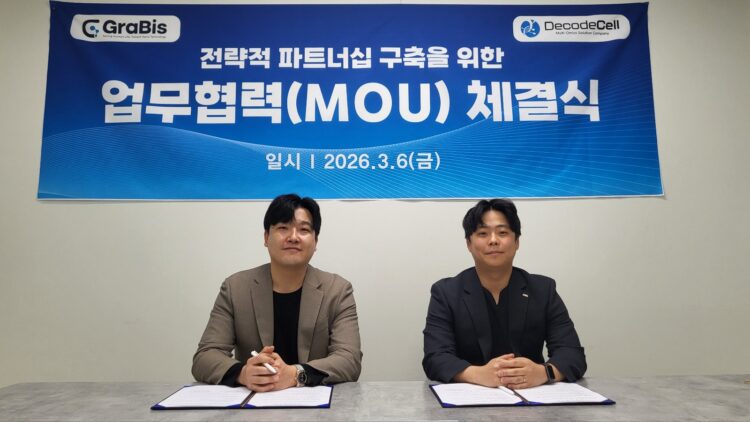
Grabis Co., Ltd. (CEO Lee Jin-yeop) and DecodeCell Co., Ltd. (CEO Kim Se-won) signed a Memorandum of Understanding (MOU) on the 6th at the Grabis headquarters in Guro-gu, Seoul. The partnership aims to strengthen competitiveness in next-generation sequencing (NGS) and single-cell multi-omics, creating a collaborative model that sharpens both the "upstream" and "downstream" of the genomic pipeline.
Grabis specializes in "magnetic bead" technology, a cornerstone of the NGS library preparation process. These ultra-fine particles act like microscopic magnets, attracting specific DNA or RNA strands while filtering out unnecessary fragments. Essentially, they serve as a "cleaner" that removes noise from genetic material. While Korea has historically relied on imports for these materials, Grabis—backed by technology holdings from Korea University and Pusan National University—has successfully localized the technology.
DecodeCell operates on the analytical end of the spectrum. The company specializes in single-cell transcriptomics, spatial transcriptomics, and multi-omics services. They act as the "detective," precisely identifying which genes an individual cell is activating and what signals are being emitted from specific locations within a tissue.
A Domestic Workflow Built for Speed and Quality
The core value of this MOU is the creation of a purely domestic platform that allows Korean researchers to perform genomic analysis from start to finish. Currently, the local field relies heavily on foreign materials and software, leading to high costs and supply chain vulnerabilities.
By utilizing Grabis’ magnetic beads to enhance the purity and yield of DNA/RNA in the pre-processing stage, DecodeCell’s platform can produce significantly more accurate results. "This agreement is a starting point for cooperation that enhances research accessibility by combining core materials with advanced multi-omics capabilities," said DecodeCell CEO Kim Se-won.
From the Laboratory to Precision Medicine
The collaboration extends beyond basic research reagents into the realms of biomarker discovery and new drug development. Single-cell analysis has become a vital tool in global pharmaceuticals, particularly in mapping the tumor microenvironment (TME) to predict how patients will respond to immuno-oncology drugs.
While Grabis provides the stable foundation for sample quality, DecodeCell acts as the "analysis engine" that provides clinical insights for pharmaceutical companies and hospitals. Grabis CEO Lee Jin-yeop noted, "We will systematically verify how pre-processing quality impacts multi-omics results, expanding our reach into diagnostics and clinical areas to complete a globally competitive domestic platform."
Technological Independence for ‘K-Health’
This partnership marks a significant step toward material independence in the Korean biotech ecosystem. Much like the localization of semiconductor materials, domestic production of magnetic beads reduces research disruptions caused by global supply chain shifts.
In the long term, the companies aim to export this integrated solution to global markets, particularly in Asia and Southeast Asia. By connecting high-quality consumables with precise interpretation services, Grabis and DecodeCell are positioning Korean biotech as a self-sufficient leader in the era of precision medicine.