“If you miss one tiny signal, you could lose a life (Missing one tiny signal Cost a Life).”
On the afternoon of the 20th, at the ‘2026 Busan Local Industry Showcase’ held at BEXCO Exhibition Center 2 in Haeundae, Busan, universities in the Busan area, local companies, and research institutions gathered to share technology and explore collaboration possibilities. Unicorns and rookies fostered by Busan Tech Holdings Co., Ltd. also held their IR (Investment Presentation), where CEO Lee Jin-yeop of the bio venture GraBis summarized the essence of early disease diagnosis.

Moreover, as precision and preventive medicine have become hot topics, the competitiveness of medical technology no longer rests solely on ‘treatment’ itself. How early and accurately risk signals are captured determines the success or failure of treatment.
“There is a signal, but it cannot be captured”
However, early diagnosis of severe diseases, including cancer, is generally difficult. The reason is clear. In the early stages of the disease, the amount of biomarkers (e.g., ctDNA, cfDNA, exosomes, etc.) circulating in the patient's body is extremely low.
In fact, the circulating tumor DNA (ctDNA) contained in 1mL of blood is only about 0.02% of the total DNA. It is difficult to reliably isolate this tiny signal with conventional technology.
The difficulty of the separation process is also a hidden challenge. Blood contains numerous substances mixed together, including DNA, RNA, proteins, cells, viruses, and exosomes. If the desired biomarker cannot be precisely separated and concentrated from this mixture, the accuracy of subsequent PCR or NGS analysis will inevitably decrease.
CEO Lee Jin-yeop referred to this point as the ‘bottleneck of early diagnosis’. No matter how sophisticated the analysis technology is, if the sample is not properly organized in the preceding stage, it is easy to miss the ‘signal’.
“The analysis technology currently used in the medical field has become quite sophisticated. The problem lies in the preceding stage. How accurately the desired biomarker can be separated before analysis ultimately determines the accuracy of the diagnosis.”
Unique Separation and Concentration Technology...Aiming for Early Diagnosis Accuracy
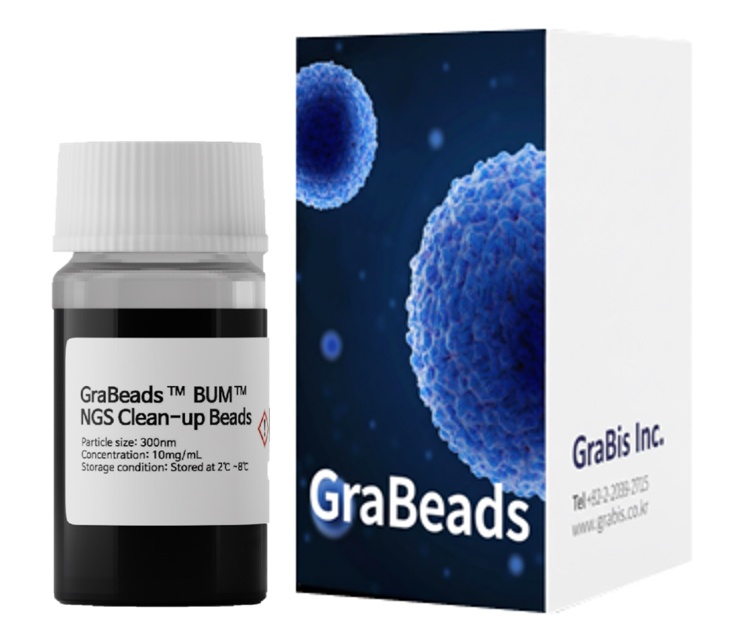
The solution presented by GraBis is the ultra-high sensitivity separation and concentration platform (GraBeads®). This technology, based on magnetic beads, focuses on efficiently capturing, separating, and concentrating trace amounts of biomarkers in blood.
CEO Lee stated, “Compared to existing methods, GraBis (GraBeads®) provides separation performance improved by more than 10 times and analysis results improved by over 30% by reducing sample loss,” adding, “It is not just about increasing sensitivity, but a technology that delivers biomarkers in a state suitable for analysis.”
In early diagnosis, how reliably the signal can be captured is more important than simply whether it exists or not, which means GraBis (GraBeads®) is responsible for that preceding stage.
From Liquid Biopsy to PCR, NGS...A Complete Pipeline
GraBis's technology does not stop at a single kit. During the IR presentation, a complete pipeline for early diagnosis was also presented.
First, through blood-based liquid biopsy, exosomes, cfDNA, ctDNA, etc., are separated and concentrated, and then connected to PCR or NGS (Next Generation Sequencing).
What’s more noteworthy is the range of applications. GraBis (GraBeads®) has a bead portfolio designed for various targets, including not only DNA and RNA but also proteins, exosomes, viruses, and cells. This means it can respond to multiple diseases and research purposes with a single platform.
As Preventive and Precision Medicine Grow, ‘This’ Becomes More Important
The goals of precision and preventive medicine are clear. To capture the possibility of disease accurately and numerically before symptoms appear.
To achieve this, the demand for liquid biopsy, multi-biomarker analysis, and repeated follow-up tests is rapidly increasing in the medical field. However, the starting point for all these technologies is the reliability of sample processing.
GraBis's technology is expanding its potential applications into various areas such as early cancer diagnosis, neurodegenerative disease biomarker research, infectious disease diagnosis, and personalized precision medicine research. The strategy targeting the global market for biomarkers and diagnostic consumables (approximately 6.9 trillion won) aligns with this trend.
CEO Lee stated that precision medicine is not completed with flashy analytical equipment. There must be technology that makes previously invisible signals visible for both precision and preventive medicine to be possible. This is why GraBis Co., Ltd. has focused on one tiny signal for a long time.