Whether it is a victim of a car accident with severed peripheral nerves, an athlete with a torn muscle, or a patient requiring an implanted cardiac device, modern medicine faces a persistent hurdle: restoration of function. Even when damaged tissues are meticulously sutured back together, the electrical signals—such as nerve impulses and muscle contraction commands—often fail to return. It is a biological equivalent of sewing two ends of a severed wire together without restoring the flow of electricity.
A joint research team led by Professor Cha Hyung-jun of POSTECH and Professor Song Kang-il of Pukyong National University has introduced a breakthrough to solve this problem. They have developed a "conductive bioadhesive" that not only physically connects damaged tissues but also acts as a bridge for electrical signals.
Two Decades of Lessons from the Mussel
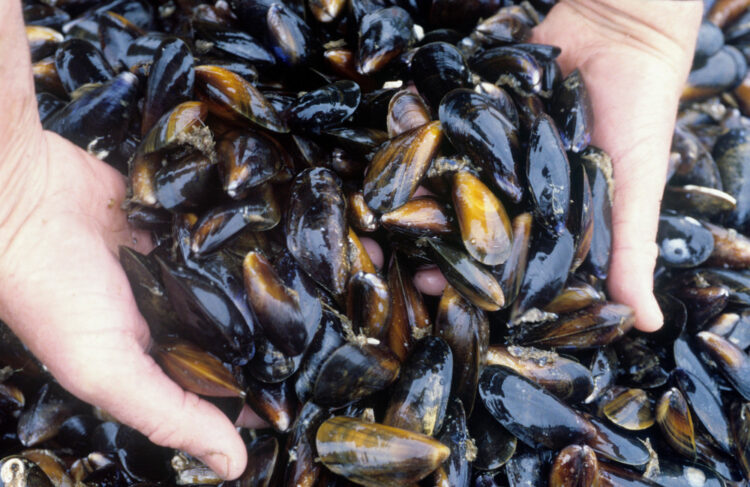
For over 20 years, Professor Cha has studied the mussel’s unique ability to remain anchored to rocks amidst crashing waves. The secret lies in a specialized byssus protein. Because the human body is filled with blood and fluids, it is essentially an underwater environment, which explains why traditional sutures are often imperfect. Mussel proteins, which thrive in wet conditions, have long been the "holy grail" for medical adhesives.
While Professor Cha’s team previously developed "FixLight"—a medical adhesive that hardens when exposed to light—challenges remained for nerve and muscle repair. Standard proteins act as insulators, blocking the very electrical signals required for functional recovery. Furthermore, light-based hardening has physical limitations when treating deep-tissue damage.
A Breakthrough in 'Electric Crosslinking'
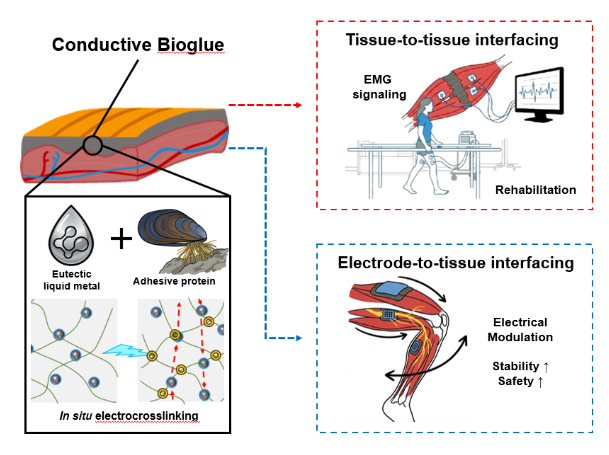
To overcome these barriers, the research team pioneered an "electric crosslinking" method. When an electrical stimulus is applied to the liquid protein adhesive, it transforms into a stable gel within minutes. This allows for the immediate fixation of tissues and electronic devices, even in fluid-filled environments deep within the body.
The team went a step further by incorporating conductive materials into the adhesive’s design. This transformation ensures the adhesive acts not just as a glue, but as a "biological wire" that transmits signals directly between tissues. The material foundation laid by Professor Cha’s mussel protein research was integrated with Professor Song’s expertise in neural interfaces and flexible electronics to create this seamless connection.
Restoring Motor Function Without Sutures
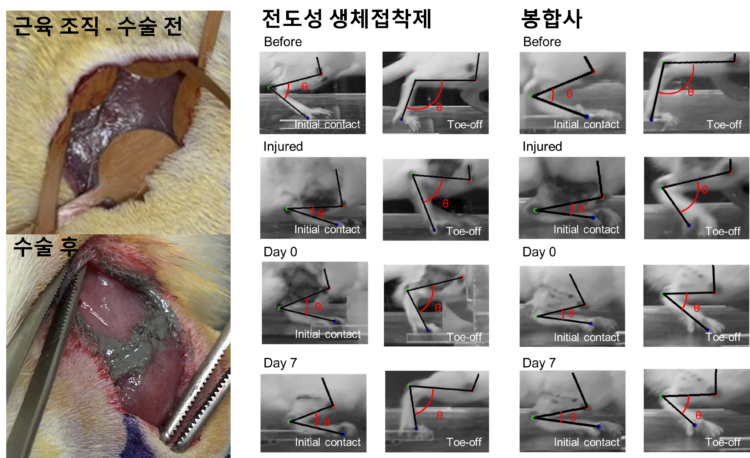
Experimental results have been transformative. When applied to severed muscle tissue, the adhesive restored electrical communication between nerves and muscles, confirming that motor function could be recovered without traditional sutures.
This technology significantly accelerates the "golden window" for nerve regeneration. Additionally, when used to attach implantable devices like heart rate monitors or brain stimulators, the adhesive reduces electrical resistance, allowing for more stable, long-term monitoring of biological signals.
"This research has opened a path to solving clinical challenges by combining mussel adhesive with electrical signals," said Professor Cha. Professor Song added that the technology represents "a new interface that stably transmits biological signals beyond just being a strong adhesive."
The research, titled In situ electrocrosslinkable and immiscible bioadhesive for robust underwater electrophysiological signal interfaces, was published online in the international journal Biomaterials and is scheduled for the May 2026 print issue. While the method must still undergo rigorous safety verification and regulatory approval for human electrical stimulation, the medical community is optimistic that this "electric glue" will soon be a staple in operating rooms.