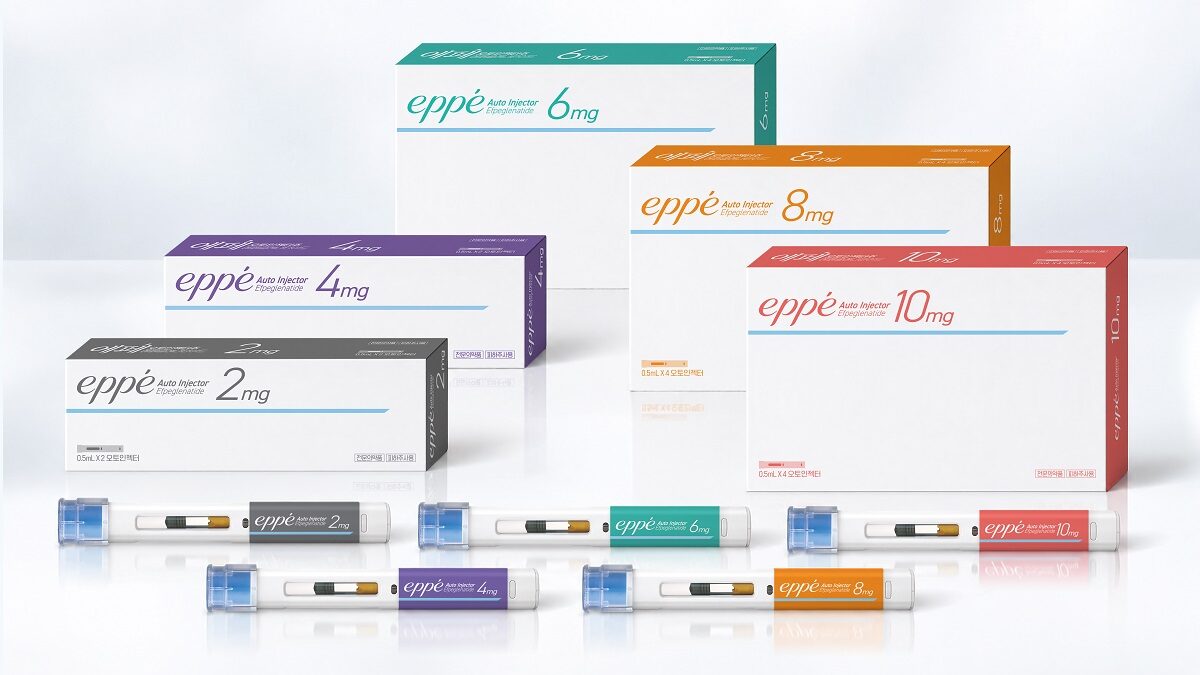
Efpeglenatide, a drug candidate whose development rights were once returned by a global pharmaceutical giant, is reemerging six years later as South Korea’s first homegrown obesity treatment. Rather than shelving the compound when Sanofi returned it in 2020, Hanmi Pharmaceutical repositioned the drug for weight management and conducted its own clinical trials. With commercial rollout expected as early as the end of this month, industry watchers are observing whether the treatment can compete in a domestic market currently dominated by imported blockbusters Wegovy and Mounjaro.
The Ministry of Food and Drug Safety (MFDS) approved Hanmi Pharmaceutical’s glucagon-like peptide-1 (GLP-1) class obesity treatment "Epe Auto-Injector Injection" (active ingredient: efpeglenatide) as the 45th domestically developed new drug in South Korea. It marks the first time a GLP-1 obesity therapy developed in-house by a Korean pharmaceutical company has earned regulatory approval.
From Shelved Asset to Domestic Approval
Efpeglenatide’s path to approval has been unconventional. Hanmi Pharmaceutical originally licensed the compound to Sanofi in 2015. The French drugmaker subsequently conducted five global Phase 3 clinical trials involving approximately 6,000 patients. However, in 2020, Sanofi returned the development rights to Hanmi as part of a broader strategic shift away from diabetes and cardiovascular research.
Rather than abandoning the candidate, Hanmi pivoted its focus toward obesity. The case represents a rare instance in which an original developer reclaimed a returned asset and independently advanced it through to regulatory approval for a new indication.
"Efpeglenatide is an asset for which Sanofi previously accumulated extensive global clinical trial data as a diabetes treatment, including demonstrated cardiovascular benefits," said Kim Seung-min, an analyst at Mirae Asset Securities. "This means it possesses a wealth of clinical data beyond simply aiding weight loss."
Weight-Loss Efficacy and Korean Trial Considerations
The immediate task for Hanmi is establishing market competitiveness alongside Novo Nordisk’s Wegovy and Eli Lilly’s Mounjaro.
In a topline analysis at week 40 of its domestic Phase 3 trial, efpeglenatide demonstrated an average body weight reduction of 9.75% from baseline. By comparison, global trial data showed Wegovy achieved an average weight loss of 14.9% at week 68, while Mounjaro recorded 15.0% to 20.9% at week 72 depending on dosage. Direct comparisons remain complex, however, due to differences in trial duration, patient demographics, and analytical methodologies. Although efpeglenatide’s Phase 3 trial concluded at week 64, those final results have not yet been publicly released.
Hanmi officials emphasize that the Phase 3 trial was conducted specifically in Korean patients. Because South Korea has a lower proportion of severely obese patients compared to populations in global trials, average percentage weight-loss figures cannot be evaluated in isolation. The company highlights the drug's efficacy, safety profile, and favorable tolerability demonstrated directly within the Korean demographic.
Pricing Strategy and Market Positioning
Pricing will play a decisive role in market adoption. In South Korea, Wegovy carries a wholesale supply price of approximately 210,000 KRW for a four-week supply of the 0.25 mg dose, while Mounjaro’s 2.5 mg dose is supplied at around 270,000 KRW. Because obesity treatments are not covered by national health insurance, actual out-of-pocket costs at pharmacies vary.
Market speculation has suggested that Hanmi might set efpeglenatide’s four-week supply price in the 100,000 KRW range. The company dismissed specific figures as speculative, stating that internal pricing decisions remain ongoing. However, Hanmi confirmed plans to manufacture the drug directly at its Pyeongtaek Bio Plant to lower production costs and reduce treatment discontinuation rates driven by financial burden.
Industry analysts suggest efpeglenatide may build market share not by attempting to outperform first movers on sheer weight-loss percentages, but by leveraging competitive pricing and Hanmi’s robust domestic sales network.
"While it may be difficult to expect weight-loss percentages on par with Wegovy or Zepbound based on current data, efpeglenatide can establish strong positioning through competitive pricing," Kim noted. "Rather than targeting patients with severe obesity, the drug is well-positioned for patient groups with relatively lower body mass index (BMI) ranges."