Nine years into the program, the cumulative total of the "Patriotism Antiphlamine Sharing Box" delivered by Yuhan Corporation to elderly national merit recipients has reached 7,361 units. As people age, chronic aches and physical discomfort tend to multiply, and the seniors who devoted their youth to the country are no exception.
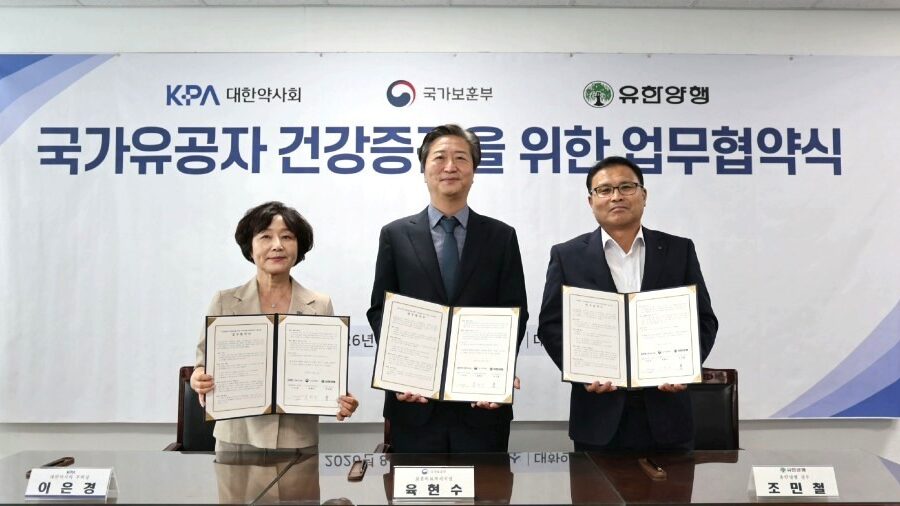
While the initiative previously operated through regional veterans offices, the effort has now expanded into a direct partnership with the central government. Ahead of Liberation Day, Yuhan announced on Aug. 14 that it signed a multilateral memorandum of understanding (MOU) on Aug. 13 with the Ministry of Patriots and Veterans Affairs and the Korean Pharmaceutical Association to promote the health of elderly national merit recipients. The agreement aims to provide systematic healthcare support so elderly veterans can maintain their health later in life.
The signing ceremony was attended by Lee Eun-kyung, vice president of the Korean Pharmaceutical Association; Yuk Hyun-soo, director general for Veterans Medical and Welfare at the Ministry of Patriots and Veterans Affairs; and Cho Min-chul, head of ESG Management at Yuhan.
Building on Local Track Record to Create a Nationwide Framework
Since 2017, Yuhan has collaborated with the Seoul Regional Veterans Office under the Ministry of Patriots and Veterans Affairs to deliver the "Patriotism Antiphlamine Sharing Box" to households of national merit recipients. Antiphlamine is a topical anti-inflammatory analgesic whose active ingredients include menthol, camphor, and methyl salicylate. Designed to help relieve pain and reduce inflammation from sprains, bruises, muscle pain, joint pain, lower back pain, shoulder stiffness, and neuralgia, the product has provided practical relief for elderly merit recipients living with chronic pain.
To date, 7,361 national merit recipients have received support under the program—an increase of 1,000 beneficiaries over the past year, up from 6,361 on Liberation Day last year. Since 2022, volunteer pharmacists affiliated with the Korean Pharmaceutical Association have also visited recipients’ homes in person, providing tailored medication guidance and health consultations alongside the medical supplies.
With the Ministry of Patriots and Veterans Affairs headquarters now joining directly as a party to the agreement, the local three-way partnership among Yuhan, the Korean Pharmaceutical Association, and the Seoul Regional Veterans Office is set to expand into a broader, nationwide public-private cooperation framework.
Geographic Expansion and the Founder's Patriotic Legacy
The updated MOU spells out clearer roles for each participating entity. The Ministry of Patriots and Veterans Affairs will identify medically vulnerable merit recipients and build the administrative foundation to ensure smooth delivery. The Korean Pharmaceutical Association will leverage its nationwide network to continue one-on-one tailored medication guidance and health consultations. Yuhan will contribute medicinal donations while overseeing financial and in-kind support so the initiative can operate stably.
The program will also expand geographically beyond the Seoul capital region. Initial expansions this year will target Yongin and Cheongju—where Yuhan’s Central Research Institute and Ochang manufacturing plant are located—before broadening further across the country in cooperation with each organization.
This milestone comes as Yuhan prepares for the 100th anniversary of its founding. Its founder, the late Yu Il-han, was an independence activist who served as Agent "A" in the "Napko Project"—a secret operation organized by the U.S. Office of Strategic Services (OSS) during World War II. The operation aimed to train 19 Korean agents in parachute and weapons tactics to infiltrate the Korean Peninsula against Japanese forces. Yuhan noted that expanding its sharing initiatives for veterans' families carries forward the founder's patriotic spirit.
Antiphlamine holds special historical significance as the first medicine Yuhan developed in-house in 1933, during the Japanese colonial period. Originally proposed by Ho Mi-ri, who operated a pediatric clinic, the ointment was created to address a reality where most available medicines in Joseon were expensive imports, forcing ordinary citizens to rely on folk remedies even for minor injuries.
"It is deeply meaningful to give back to those who devoted themselves to the country through Antiphlamine, a medicine that embodies the patriotic spirit of our founder, Yu Il-han," said a Yuhan official. "We will continue working to sustain this public-private cooperation to promote the health of national merit recipients."