Even after Hong Myung-bo stepped down as head coach of South Korea’s national football team—taking responsibility for the country's failure to reach the round of 32 at the 2026 FIFA World Cup—public disappointment and anger refuse to fade. Across online communities and social media platforms, videos venting intense frustration at Hong and the Korea Football Association (KFA) have spread like wildfire, quickly racking up millions of views.
A short-form video uploaded to YouTube on June 29 titled “A comforting video I made because I was angry because of Hong Myung-bo” has already surpassed 13 million views. The clip features an AI-generated scene showing national team midfielder Jens Castrop (22, Borussia Mönchengladbach) striking the back of the former coach's head. Castrop, born to a German father and a Korean mother, was first called up to the national squad for the September friendlies announced in August 2025 by then-coach Hong. During this World Cup campaign, Castrop sat out matches against the Czech Republic and Mexico, making his tournament debut as a second-half substitute against South Africa—a match South Korea lost 0–1.
Despite the video being entirely fictional, it has drawn over 10,000 comments, with users writing, “This is so satisfying,” “That’s exactly how the whole country feels—I’m still furious,” and “This is pure catharsis.”
The Viral Wave of Match Critiques
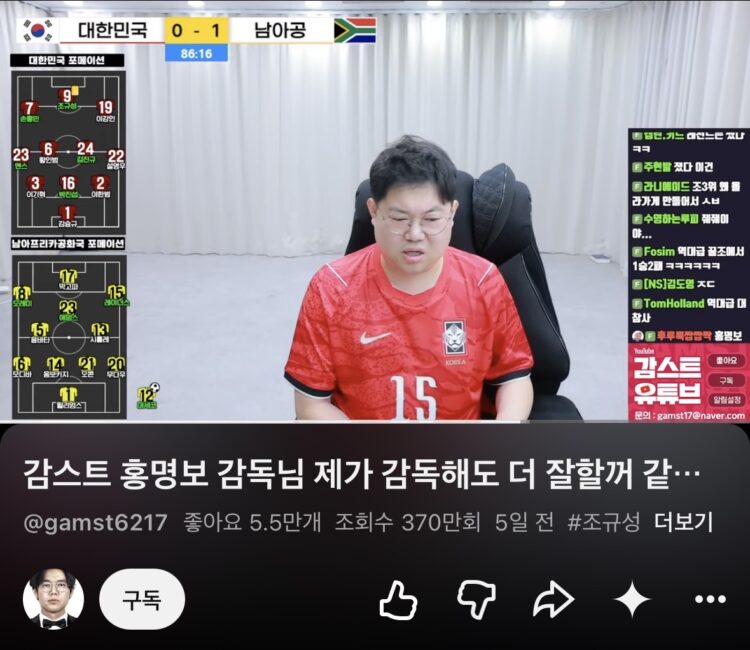
Review and reaction videos of the devastating loss to South Africa have also seen a massive surge in viewership. A live match review by prominent soccer YouTuber Gamst, who voiced intense fury during the broadcast, has topped 3.7 million views. Meanwhile, news clips and YouTube Shorts featuring 2002 World Cup legends Park Ji-sung, Lee Young-pyo, and Ahn Jung-hwan voicing blunt criticism over the team's lackluster performance and tactical management have circulated widely, drawing hundreds of thousands of views.
The deep-seated resentment toward Hong and the KFA extends far beyond a single group-stage elimination. The backlash was initially triggered by controversy surrounding the lack of fairness in the process of appointing Hong, which was later compounded by long-standing criticisms of the association's administrative failures and a perceived lack of accountability.
During the World Cup tournament itself, fans' frustration reached a boiling point over poor on-pitch performance, questionable player selection, and rigid tactical decisions. Years of simmering grievances and a sense of institutional stagnation among football fans seemingly erupted all at once following the final whistle. Comments like “This is incredibly satisfying” and “He said exactly what I wanted to say” reflect this collective exasperation.
The Illusion of Catharsis
From a psychological standpoint, sharing intense negative emotions like anger can foster mutual empathy and a powerful sense of connection. Fans experiencing shared disappointment validate one another through comment sections, finding solace in seeing their internal frustration externalized by others.
However, psychologists warn that airing grievances in this manner does not necessarily provide a healthy emotional release. While repeated exposure to shared outrage offers temporary comfort, it often keeps the underlying negative emotions active, locking individuals into a cycle of prolonged distress.
In fact, a widely cited 2002 study published in the international academic journal Personality and Social Psychology Bulletin demonstrated that dwelling on anger or repeatedly venting it can actually amplify aggression and deepen resentment rather than diminish it. Replaying clips of blame can cause fans to ruminate, keeping the emotional wound fresh rather than helping them move past it.
Ultimately, merely consuming and sharing angry content is insufficient to heal the rift. For the disappointment and outrage of South Korean football fans to truly subside, a transparent accounting of the structural issues plaguing the national team—along with genuine institutional reforms to rebuild public trust—will be required.