A domestic research team has developed a hemostatic agent that stops bleeding one second after application. Notably, an active duty Army major participated in the development process, drawing attention.
The Korea Advanced Institute of Science and Technology (KAIST) announced on the 29th that a joint research team led by Professor Steve Park from the Department of Materials Science and Engineering and Professor Jeon Sang-yong from the Department of Life Sciences has developed a next-generation powder hemostatic agent.
Existing patch-type hemostatic agents widely used in medical settings have limitations due to their flat structure, making them difficult to apply to deep and complex wounds. Additionally, they are sensitive to temperature and humidity, making storage challenging.
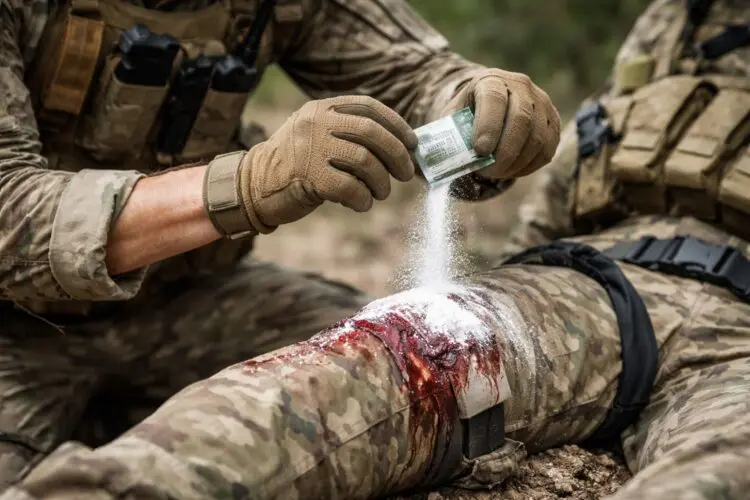
In response, the KAIST research team set out to develop a next-generation hemostatic agent in powder form that can be freely applied to deep and irregular wounds. As a result, they created a powder hemostatic agent by combining biocompatible natural materials such as alginate, gellan gum, and chitosan.
Gellan gum reacts with calcium in the blood to quickly transform into a gel state, while chitosan has hemostatic effects when it binds with blood components. Thanks to this, the new powder hemostatic agent transforms into a gel form upon contact with blood in just one second, sealing the wound immediately.
Moreover, the powder forms a three-dimensional structure inside, allowing it to absorb more than seven times its own weight in blood. This enables rapid blockage of blood flow even in high-pressure and excessive bleeding situations, and it exhibits excellent sealing performance that can withstand strong pressure when pressed by hand.
According to the research team, animal experiments utilizing the powder showed excellent tissue regeneration effects, including rapid wound healing and promotion of blood vessel and collagen regeneration. The cell survival rate was over 99%, and the antibacterial effect was 99.9%, indicating minimal impact on blood components.
In experiments simulating surgical liver damage, the amount of bleeding and hemostatic time were significantly reduced compared to currently available hemostatic agents, and liver function returned to normal levels two weeks after surgery. No abnormal findings were observed in systemic toxicity evaluations.
The research team explained, "The new type of hemostatic agent maintains its performance for two years even in room temperature and high humidity environments, making it immediately usable in harsh conditions such as military operation sites or disaster areas."
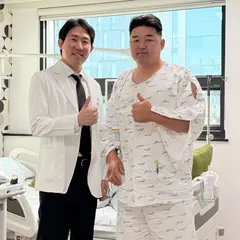
Dr. Park Kyu-soon, a doctoral student who participated in this research as an active duty Army major, stated, "I started this research with a sense of mission to save even one more soldier," and added, "I hope the technology developed this time will be used as a life-saving technology in both defense and civilian medical settings."