You take your medication, but before long, stiffness returns and your hands begin to tremble. With the next dose still hours away, you enter what Parkinson’s disease patients call "off time"—the distressing periods when medication wears off and motor symptoms resurface.
In clinical trials, patients experienced an average of 5.5 hours of daily off time. However, when a new oral therapy was added to standard medication, daily off time dropped by nearly an hour more compared to a placebo.
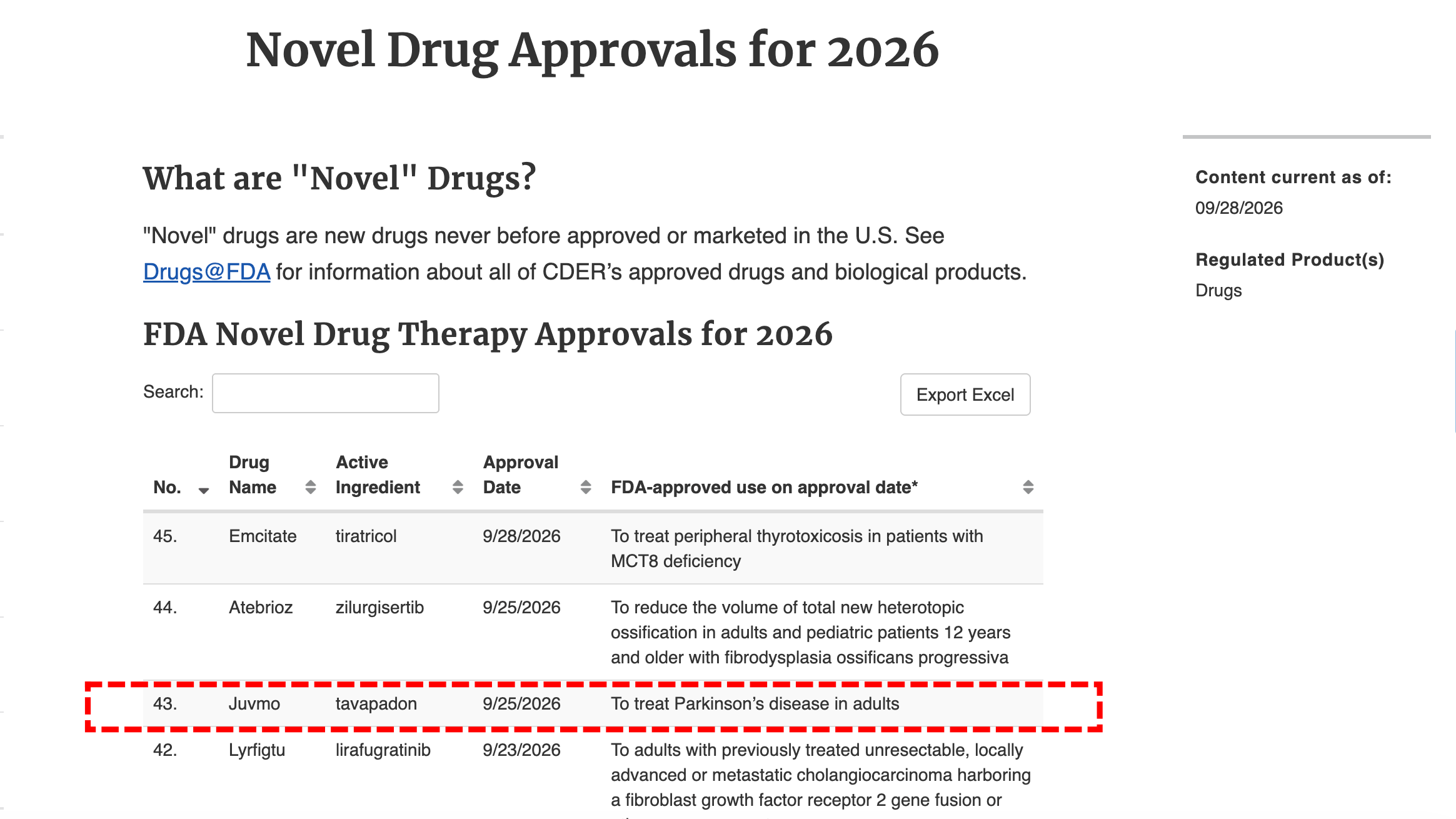
On September 25, the U.S. Food and Drug Administration (FDA) approved AbbVie’s oral Parkinson’s disease treatment Juvmo (tavapadon) for adult patients. The approval marks the FDA’s 43rd new drug clearance of the year, with AbbVie announcing the decision on September 28.
Administered once daily, Juvmo represents a novel mechanistic class. Unlike traditional dopamine receptor agonists that primarily target D2 and D3 receptors, Juvmo selectively activates the D1 and D5 receptor subtypes.
According to AbbVie, Juvmo is the first Parkinson’s disease medication approved using this selective D1/D5 receptor activation approach.
Daily "Off" Time Reduced by Nearly One Hour Over Placebo
The FDA approval was supported by results from TEMPO-3, a Phase 3 clinical trial enrolling 507 patients who experienced motor fluctuations despite ongoing levodopa therapy. Participants had a mean age of 64.9 years and averaged 5.5 hours of daily off time at baseline.
After 26 weeks of treatment, daily off time decreased by 1.88 hours in the Juvmo add-on group, compared to a 0.93-hour reduction in the placebo group—a statistically significant net reduction of 0.94 hours per day.
Conversely, patients experienced a meaningful increase in "on time"—periods when motor symptoms are well-controlled without troublesome dyskinesia (involuntary movements). Daily on time increased by 1.70 hours in the Juvmo group compared to 0.60 hours in the placebo group, delivering an additional 1.10 hours of functional motor control per day over placebo.
Complementing Standard Levodopa Therapy
In the TEMPO-3 trial, Juvmo was evaluated as an adjunctive therapy alongside established levodopa regimens. Rather than replacing levodopa, the drug is used conjointly to reduce wearing-off fluctuations between scheduled doses.
Juvmo can also be prescribed as monotherapy for early-stage Parkinson’s patients who have not yet started levodopa. In the TEMPO-1 and TEMPO-2 trials, which evaluated early-stage patients, 26 weeks of Juvmo monotherapy yielded significant improvements in motor function and daily living activities compared to placebo.
In TEMPO-3, the most common adverse events reported in the Juvmo group included nausea (14.3%), dyskinesia (10.0%), and dizziness (7.6%).
AbbVie plans to launch Juvmo commercially in the United States in October.