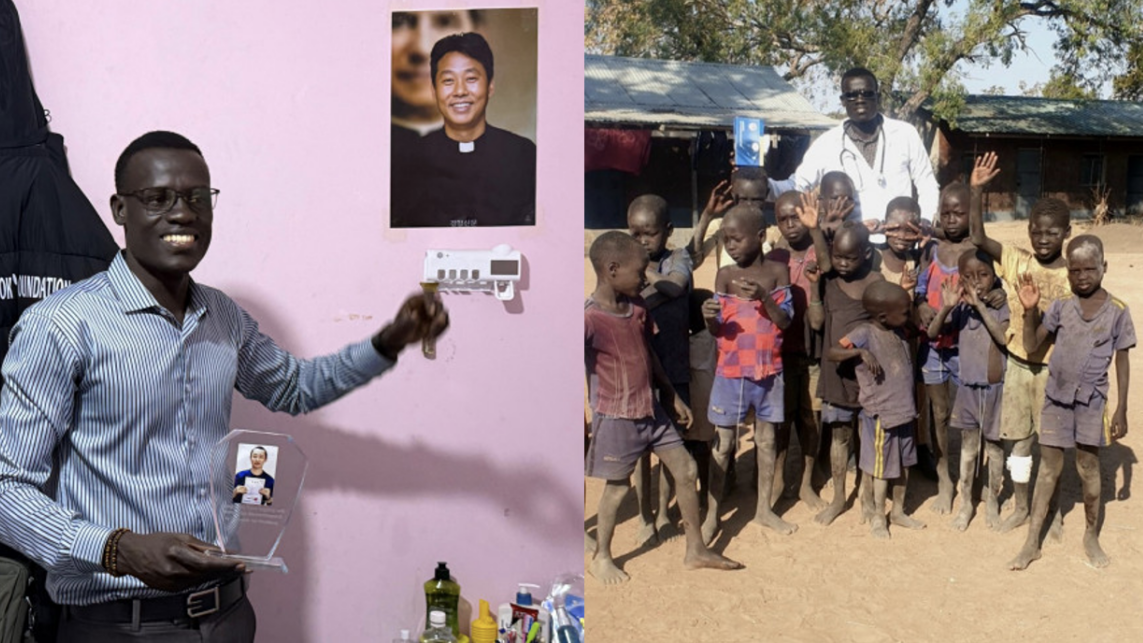
A South Sudanese boy featured in the documentary film Don’t Cry for Me, Sudan alongside the late Father Lee Tae-seok has fulfilled his dream of becoming a medical doctor 16 years later.
The Lee Tae-seok Foundation announced on Aug. 18 that Joseph Bol has officially become South Sudan’s first board-certified neurologist.
The documentary Don’t Cry for Me, Sudan chronicled the life of Lee Tae-seok, a South Korean Catholic priest and physician who dedicated more than eight years to medical care and education in southern Sudan. Bol appeared in the film as a child who met Lee in Sudan (now South Sudan) and was inspired by him to pursue a career in medicine.
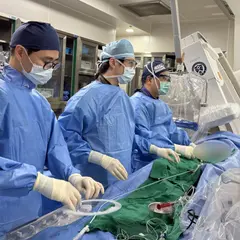
Bol completed his residency at Black Lion Hospital, the teaching hospital of Addis Ababa University in Ethiopia, where he earned his specialist certification. The Lee Tae-seok Foundation noted that a remarkable cross-border connection helped Bol achieve his goal.
A Dream Carried Across Borders and Time
Kwon Sung-hyun was diagnosed with leukemia during his senior year of high school. Although he passed the entrance examination for Seoul National University College of Medicine, Kwon died before he could realize his dream of becoming a doctor. Wanting another young person to complete the journey their son could not finish, Kwon’s parents donated the equivalent of six years of university tuition to the Lee Tae-seok Foundation.
The foundation selected Bol as the recipient of the Kwon Sung-hyun Scholarship, using the donation to cover his specialist residency and training expenses.
Expressing his gratitude to Kwon’s parents, Bol pledged, "I will return the love and support I received from you both to each and every patient I care for."
Koo Jin-sung, head of the Lee Tae-seok Leadership Academy, met Bol in person and recalled being deeply moved to see a photograph of Lee Tae-seok displayed in Bol's room. "Sixteen years later, he still holds close in his heart the mentor who first planted that dream within him as a child," Koo said.
Carrying Forward a Humanitarian Legacy
The Lee Tae-seok Foundation, a public-benefit organization affiliated with the United Nations, continues the work of the late priest, who was widely known as the "Schweitzer of Sudan."
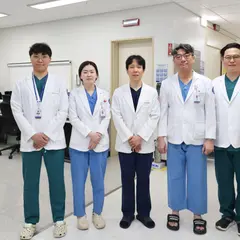
Since July, the foundation has hosted nine of Lee’s former students in South Korea for clinical training at Wonkwang University College of Medicine. The trainees are sixth-year medical students or recent medical graduates preparing to enter practice.
Bol represents the first medical specialist produced through the foundation’s talent development program. A video featuring Bol’s journey, posted on the YouTube channel "PD Koo Soo-hwan’s Empathy 36.5," drew significant attention, surpassing 80,000 views within two days of publication.
"The spirit of Lee Tae-seok endures by developing leaders who return to serve their own countries and neighbors," the foundation said. "We will continue our efforts to drive sustainable, long-term change."