"I want my face to look smaller and slimmer. Please make my chin smaller."
This is a phrase commonly heard during consultations for facial contouring surgery. However, contrary to what people often expect, surgery to reduce the chin does not make the face smaller and slimmer. Instead, it tends to make the face appear wider and flatter, giving it a dull look.
This paradox can be relatively easily understood by looking at the facial shapes of Koreans. The facial shape of East Asians, including Koreans, is relatively wider, shorter, and flatter compared to that of Westerners. Interestingly, the facial shapes considered attractive in both East and West are closer to the average of these two.

If we simplify this into an oval shape, it feels like the illustration below.
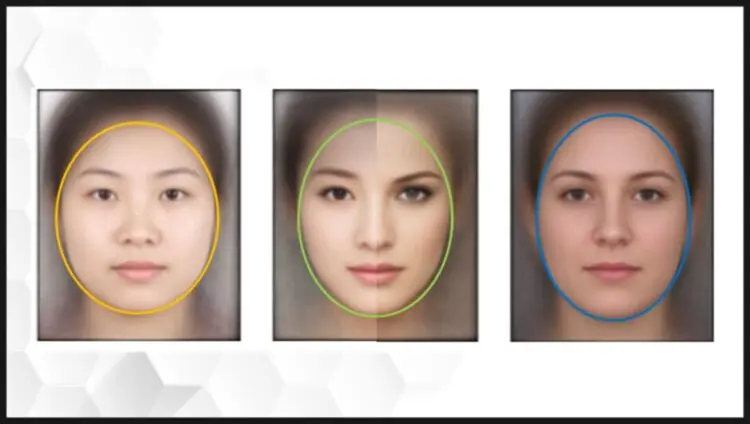
When looking at just the oval, it can be seen that the chin is actually lacking in Korean faces.

If the chin is further reduced or pushed back, the facial boundaries collapse, making the area visually appear larger. Thus, surgery that shortens the chin paradoxically becomes a major culprit in making the face look bigger. In particular, surgery that shortens the chin is a common cause of making the face appear wider.
The ideal facial ratio we often talk about is that the upper, middle, and lower face should be in a 1:1:1 ratio. This is a standard established in the fields of art and medicine throughout history. However, at some point, advertisements for plastic surgery began to spread the notion that a ratio of 1:1:0.8 or 1:1:0.9 is a new standard of beauty.
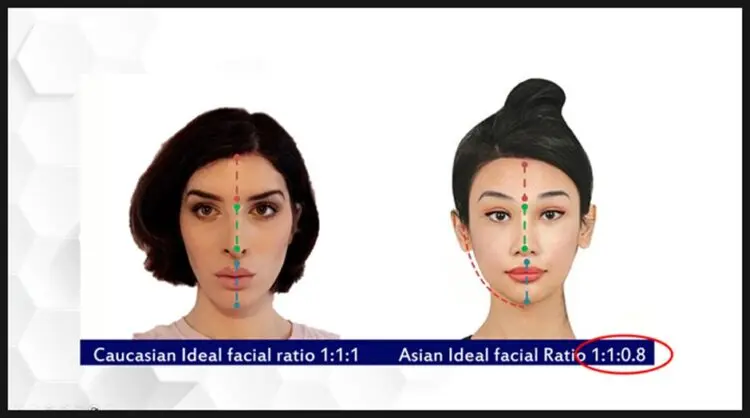
These figures are merely commercial marketing phrases with no medical basis whatsoever. In fact, when measuring the faces of the beauties that the public admires, most maintain the golden ratio of 1:1:1.
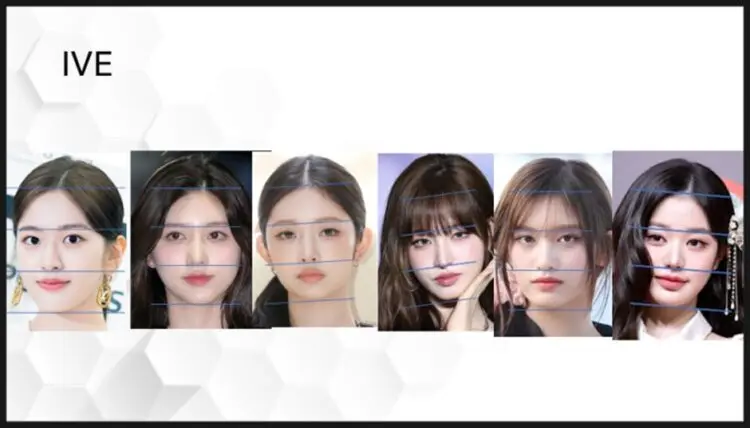
Nevertheless, advertisements imprinted with numbers like 1:1:0.8 have captured the public's memory more powerfully than the truth, solidifying into what seems like a scientific fact without verification.
The problem is that many cases have emerged where people, misled by such advertisements, have reduced their chins, resulting in an imbalance and awkwardness in their faces. The unnatural jawline or the double chin phenomenon caused by excessive reduction is also a tragedy brought about by this.
The chin is an indicator that determines the overall impression of the face. The vertical length determines the overall proportion, the width influences the flow of the side profile, and the front-back position determines the depth of the face. In fact, many individuals who were troubled by their faces still appearing wide after facial contouring surgery can see significant improvement simply by restoring the proportion of their overly reduced chin.
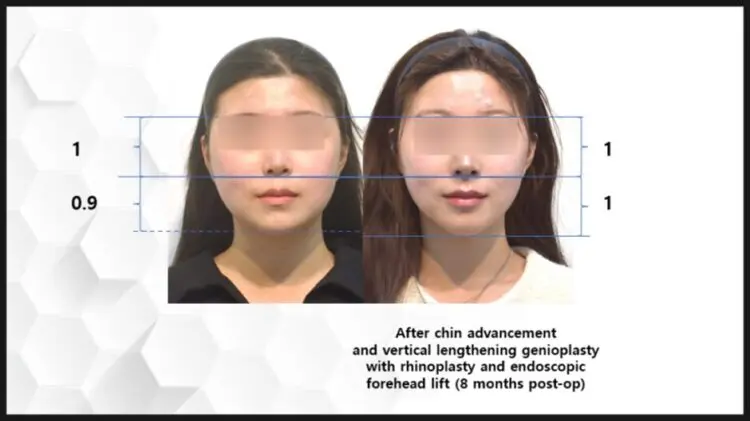
By appropriately repositioning a short and pushed-back chin, the 'side profile' of the face comes to life. The natural shadows created at this time create a visual three-dimensionality, making the face appear smaller.
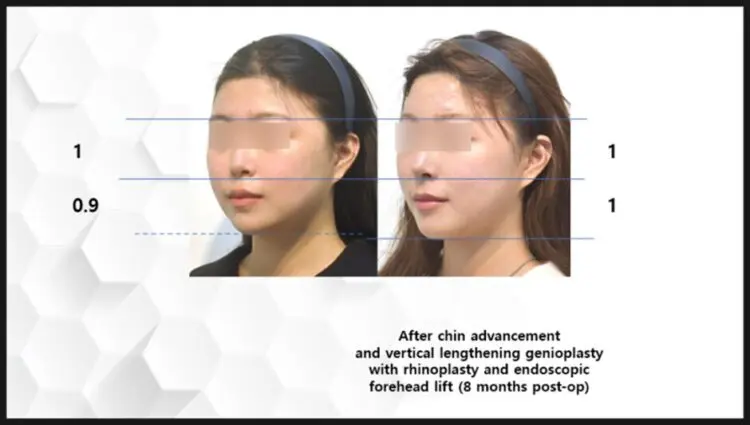
However, many still believe that a 'small chin' equates to a 'small face.' It is unfortunate that some experts also ride the wave of such demands, recommending indiscriminate reductions.
The answer to making a Korean face appear smaller does not lie in 'chin reduction.' It is not about indiscriminately cutting down but rather about the doctor's ability to find the natural and ideal proportions and depth in each individual's facial shape that is most important.