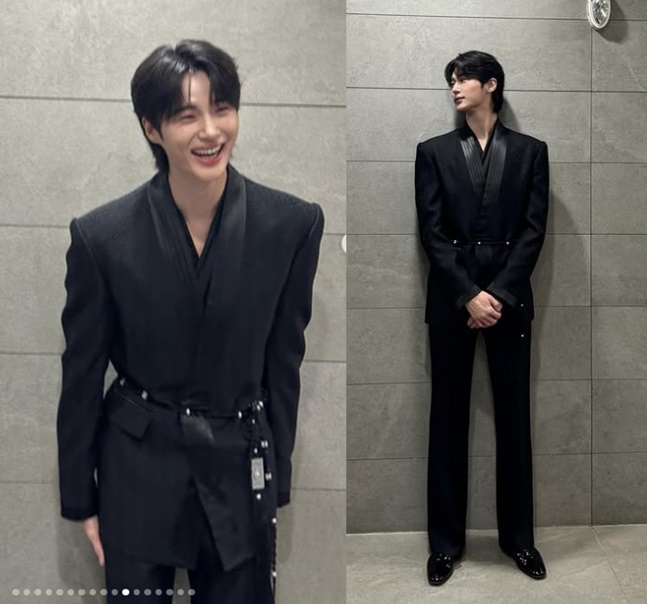
Actor Byun Woo-seok (34), who is a former model, has not stopped exercising even in Milan.
Byun Woo-seok's recent status was captured in a photo shared by Thai actor Metawin Opas-iamkaew on his social media (SNS) on the 19th. In the photo, Byun Woo-seok is dressed in sleeveless workout clothes, showcasing his slim body line, broad shoulders, and strong arm muscles.
Byun Woo-seok visited Milan, Italy, to attend a fashion show for the luxury brand Prada, and he continued his workout routine even during his overseas trip.
Byun Woo-seok rose to fame as the character Ryu Seon-jae in the tvN drama ‘Seon-jae Up and Fly’ and will be co-starring with singer and actress IU in the MBC drama ‘21st Century Great Lady’ scheduled to air in the first half of this year. Standing at 190cm, Byun Woo-seok maintains a slim physique without any excess fat, while being known as the epitome of 'Door Frame Man' (a neologism referring to a tall man with broad shoulders like a door frame).
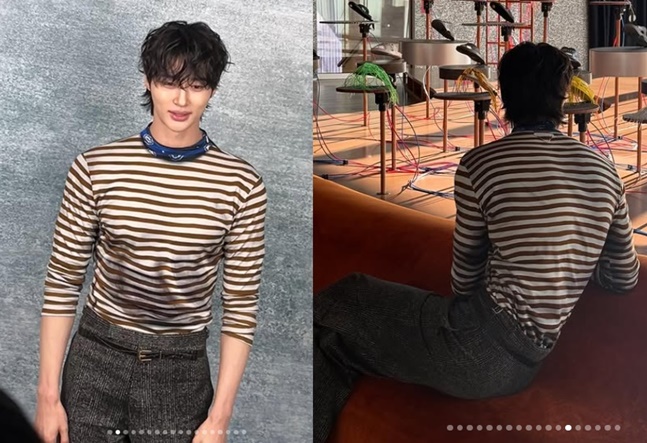
Netizens who saw the photo commented, “His body is slim, but he has broad shoulders and arm muscles,” “How do you build a body like that?”, “Exercise habits are indeed important. Starting from today,” “He looks so pretty in a knit fit because he is slim,” “Born with it and also putting in effort... I feel inspired,” expressing admiration for Byun Woo-seok's physique and efforts.
In a previous interview, Byun Woo-seok stated, “I maintain a body fat percentage of about 10%. Since it’s a visible profession, I try to keep my weight and body fat percentage from fluctuating as much as possible,” adding, “I mainly eat protein, but I can’t give up on sauces. Instead, I exercise a lot. There are so many delicious things in the world, so I relieve stress with food.”
How can one achieve a slim body with broad shoulders and strong arm muscles like Byun Woo-seok?
The Secret to a Slim Body: Aerobic Exercise
The body type of actor Byun Woo-seok, captured at a gym in Milan, featuring a ‘slim body + broad shoulders + arm muscles’, cannot be achieved by focusing on just one area. The key strategy is to change the ‘silhouette’ by not excessively increasing body fat (slim) while increasing muscle mass in the shoulders, back, and arms (broad and strong upper body). At the center of this is the division of roles between aerobic (endurance exercise) and strength (resistance exercise).
Among these, a slim impression ultimately depends on body fat management. It is recommended for adults to engage in moderate-intensity aerobic exercise for at least 150 minutes per week (or more than 75 minutes of high-intensity), and strength training should also be done at least twice a week. For health and a slim body, aerobic exercise should be done 3-5 times a week, with 30-45 minutes of brisk walking, running, cycling, or swimming being appropriate. If you want to reduce body fat further, you can increase the exercise time to 200-300 minutes per week or increase the intensity with high-intensity interval training. However, if you do too much aerobic exercise every day, it can decrease the performance of strength training, making it difficult to increase shoulder and arm volume, so adjustments are necessary.
The Secret to Broad Shoulders and Strong Arms: Strength Training
Having broad shoulders and arm muscles is important not only for the type of exercise you do but also for maintaining weekly exercise time. A body type that appears to have broad shoulders is not simply due to wide shoulder blades, but rather the ‘upper body frame’ created by the deltoids (shoulders) + latissimus dorsi/upper back (back) + arms (triceps and biceps) becoming larger. Therefore, it is recommended to do strength training at least twice a week.
To build muscle, it is generally effective to perform moderate repetitions (about 6-12 reps), multiple sets (3-6 sets), and moderate intensity (approximately 60-80% of 1RM). The feeling of ‘being slim but having thick arms’ is most easily achieved when the volume of the arms themselves and the shoulder and back frame grow together. A strength routine for growing shoulders and arms includes ▲ 3-4 times a week (2 times upper body + 1-2 times lower body) ▲ aiming for 10-20 hard sets per week for each area (starting with 8-12 sets and increasing as you adapt) ▲ the number of repetitions per set is 6-12, and repeating the same movement with a challenging weight for the last 1-3 reps will increase shoulder and arm size.
Looking at the exercises for each area, ▲ for broad shoulders (deltoids), overhead presses (dumbbell/barbell), side lateral raises (focusing on accurate trajectory rather than weight), and face pulls/rear delt flies to develop the rear deltoids are appropriate, while ▲ for making the shoulders appear broader (latissimus dorsi/upper back), pull-ups/lat pulldowns (latissimus dorsi), and rows (back thickness + posture: barbell/dumbbell/cable) are recommended. For arm muscles (especially ‘thickness’ is determined by the triceps), dips, cable pushdowns, and overhead extensions are good for triceps, while barbell/dumbbell curls and hammer curls are recommended for biceps.
The three principles for a balanced arrangement of aerobic and strength training are ▲ on days focused on building muscle, do weights first ▲ if both need to be done on the same day, separate the sessions (if possible, space them out) ▲ aerobic exercise should be ‘consistent’ rather than ‘excessive’. Often, 2-4 times a week is sufficient for body fat management.
If you have any health issues, joint pain, or are overweight, high-intensity interval training or running can increase the risk of injury, so caution is advised. If you feel a sharp pain during exercise or it persists, stop exercising and consult a professional.
Slim + Muscle, the Final Puzzle is Protein and Rest
Without protein and recovery, ‘slim + muscle’ cannot happen simultaneously. Protein and recovery are as important as exercise. The International Society of Sports Nutrition (ISSN) recommends that most exercising adults consume 1.4-2.0g of protein per kg of body weight for muscle adaptation. If you weigh 70kg, you should consume 98-140g of protein after strength training, divided every 3-4 hours. This is why Byun Woo-seok, who maintains a body fat percentage of 10%, primarily eats protein. Adequate sleep and recovery are also important. Without sufficient recovery, even if you increase aerobic exercise, you may not look slim but rather appear fatigued.