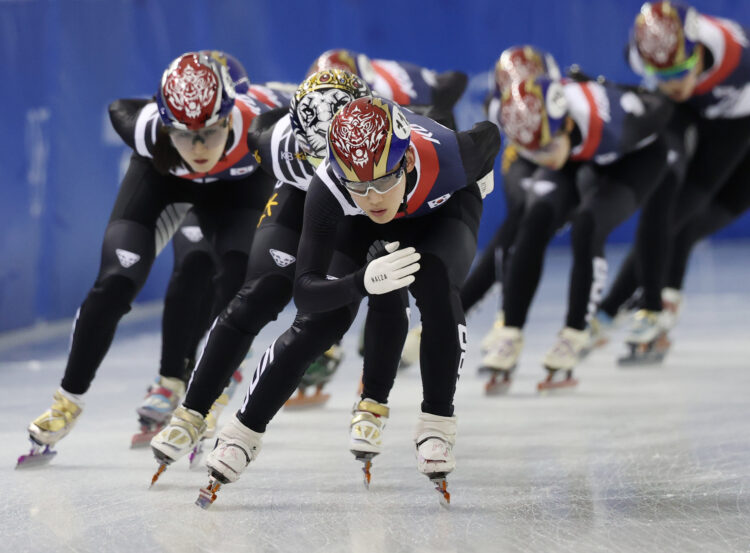
The Milan-Cortina Winter Olympics will kick off on the 6th of next month. Athletes will compete for a total of 116 gold medals across 8 sports and 16 events. Our country is aiming for medals in short track, where we have traditionally shown strength.
In short track events, particularly intense scenes often arise. It is common for athletes who lose their balance during cornering to collide with the wall outside the track. Short track keeps your eyes glued to the screen throughout the competition. Before moving on to other events, some may have wondered, 'But why do athletes in short track and other ice sports turn counterclockwise?'
Athletes also run left around the corners of the track in athletics. It’s not just athletics and ice sports. In baseball, batters also run around the bases counterclockwise.
"Humans instinctively follow the direction of the Earth's rotation"
Several explanations have been proposed for this reason: the Earth's rotation theory, heart position theory, and right-handedness theory. The Earth's rotation theory suggests that if viewed from above the North Pole, the Earth rotates counterclockwise, and thus people also turn counterclockwise like the Earth. The heart position theory argues that since the heart is tilted to the left, it is more advantageous for balance to turn corners with the center of gravity on the left. The right-handedness theory explains that right-handed people are more accustomed to turning left.
Among these, the Earth's rotation theory can be easily refuted. Although humans pride themselves on being the most intelligent species, no one feels the Earth's rotation. Even if one does not feel it, if one instinctively knows the direction of rotation, situations where one loses direction in nature would not occur. Furthermore, the observation that the Earth rotates counterclockwise is based on the perspective of an observer above the North Pole. If viewed from above the South Pole, the Earth rotates clockwise.
"Since the heart is on the left, it is more comfortable to turn left"
The heart position theory explains that turning right on the track can easily disrupt the body's balance. This sounds plausible. But let’s think for a moment. Have you ever heard the explanation that 'the center of gravity of the human body tilts to the left because the heart is tilted to the left'? Probably not. The heart is on the left, but the liver is on the right. The heart weighs about 300g for an adult, while the liver weighs 1.4 to 1.7kg. One could say that the liver corrects the slightly shifted center of gravity of the heart to the left.
The remaining hypothesis is the right-handedness theory. About 90% of the world's population is right-handed, and this ratio is similarly observed among athletes. Right-handed people find it more comfortable to use their right foot. When turning left on the ice, it is easier to gain propulsion by placing the right leg on the outside and pushing off the ice. The motion of swinging the right arm can also be done more naturally and powerfully. The same principle applies in athletics, where right-handed athletes find counterclockwise movement more comfortable.
“Right-handed people are used to pushing off with their right leg”
The changes in how Olympic events have been conducted support the right-handedness theory. The first Olympic Games in 1896 were held in Athens. At that time, the organizing committee operated the athletics events so that athletes would run clockwise around the track. This led to complaints from the athletes. They said, “It’s awkward and uncomfortable, and the records are not good.” This reaction gained traction. Eventually, the International Association of Athletics Federations created international regulations that allowed athletes to run left around the track.
Right-handed people use their left leg for support and their right leg for the main action. A simple example of this is seen in scooters or merry-go-rounds. Right-handed people push off the ground or roll with their right foot to gain propulsion. The same principle applies when turning on an athletics track. The left leg supports the body while the right leg pushes off the ground to propel the body forward.
This raises an additional question. The left leg of a right-handed person plays the role of maintaining the center of the body for a longer time. So, wouldn’t the left leg of a right-handed person be more developed and heavier than the right leg? In fact, there are people who argue this. I also previously speculated that the left-right leg imbalance shown when measuring muscle mass with an InBody would vary depending on whether one is right-handed or left-handed.
Is the more frequently used leg stronger, or is the supporting leg sturdier?
The right leg of a right-handed person is called the 'dominant leg', while the left leg is called the 'non-dominant leg'. Is it true that the non-dominant leg of a right-handed person has more muscle? According to a related paper (Lower Extremity Muscle Morphology in Young Athletes: An MRI-Based Analysis, Tate et al., 2006), the conclusion is 'it varies by muscle'. Some muscles in the non-dominant leg are large, while others are small. In short, it cannot be said that the left leg muscles of right-handed people are more developed. (The hypothesis of this paper was that the dominant leg is more developed.) The study was conducted by comparing the muscle volume, cross-sectional area, and length of various muscles in the participants' lower limbs using MRI.
Now is a good time to compare the muscle mass of your left and right legs using an InBody. Let’s check if the dominant leg has more muscle mass.
Knowing the reason for turning left on the track may make the winter Olympic ice sports more interesting. Left-handed people may find counterclockwise movement disadvantageous, so is the proportion of left-handed athletes among world-class ice skaters low? This question will be left for future exploration.